

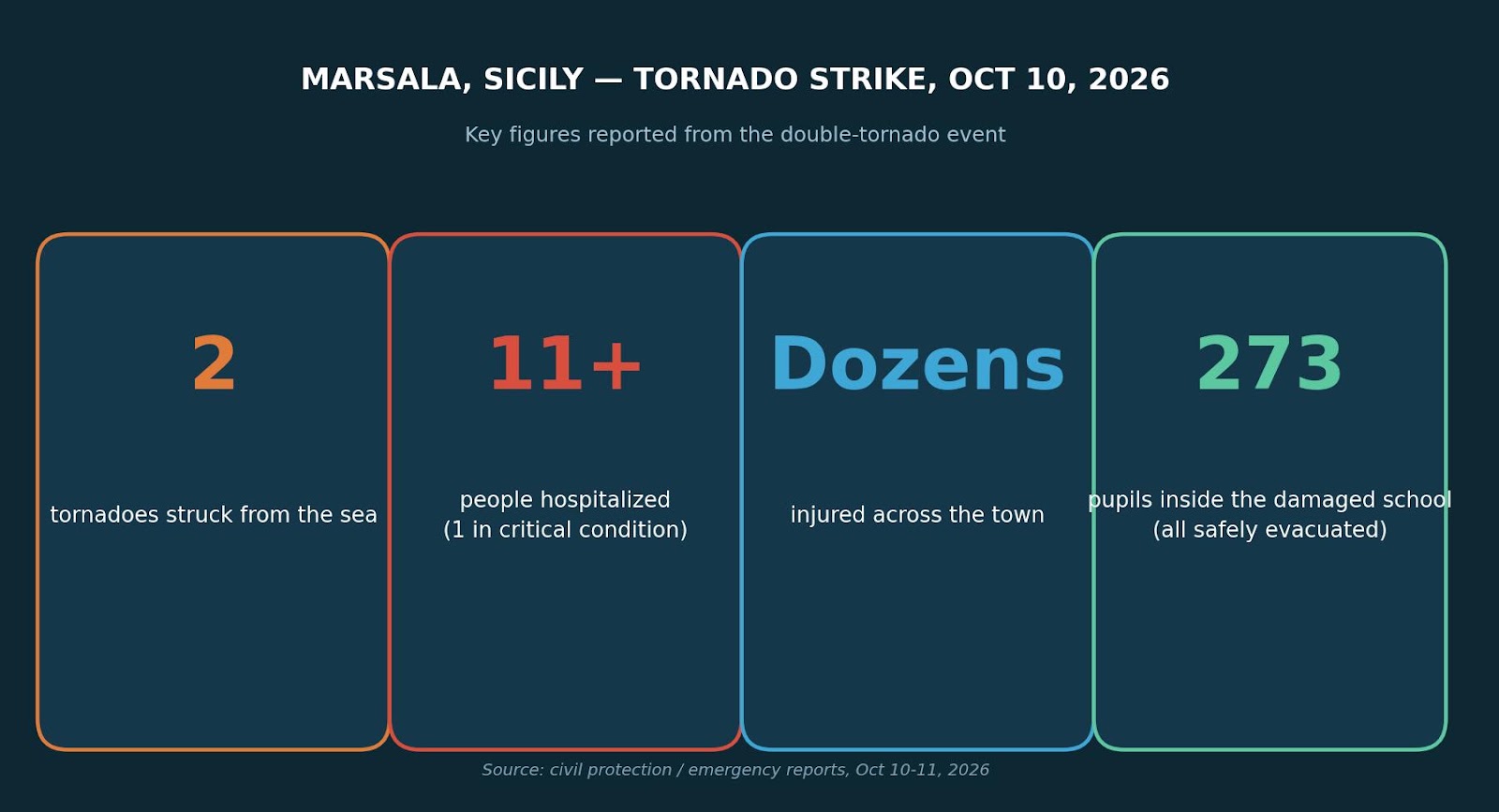
On October 10, 2026, the Mediterranean served up a brutal reminder that it is no longer the calm, postcard sea of the tourist brochures. Two tornadoes formed over the water and slammed into Marsala, a coastal town in western Sicily, injuring dozens and damaging a school while 273 pupils were inside. It was one of the most dramatic severe-weather events Italy has seen in years — and experts say it fits a pattern that is becoming harder to ignore: the Mediterranean is facing more frequent, more violent extremes, driven by a warming sea and shifting climate dynamics.
This article explains what happened in Marsala, what the science says about why tornadoes and waterspouts are hitting Mediterranean coastlines more often, and — most importantly — how cities, schools, and families can prepare for a future where storms like this are no longer freak accidents.
What Happened in Marsala on October 10
The town of Marsala sits on Sicily's western coast, facing the open Mediterranean. On October 10, two separate tornadoes approached from the sea and came ashore, tearing through parts of the town with little time for residents to react.
The damage was immediate and frightening. Roofs were ripped away, windows shattered, street furniture and debris were thrown across roads, and overturned objects were reported across the affected neighborhoods. Emergency services rushed to the scene as calls for help multiplied.
At least 11 people were hospitalized, including a 70-year-old man who suffered multiple fractures and was reported in critical condition. Dozens more sustained injuries of varying severity — cuts from flying glass, bruises, and shock-related trauma. In a town not used to defending itself against twisters, the event's speed caught many people outdoors or near windows — the most dangerous places when a tornado strikes.
The most alarming chapter unfolded at a local school. The tornado damaged the school building while 273 pupils were inside. Shattered windows and overturned furniture sent fear through the classrooms, and six children sustained minor injuries. Thanks to the quick response of teachers and staff, all were safely evacuated, and emergency teams secured the area. For the parents waiting outside, those minutes of uncertainty were unbearable — and they raised a question now being asked across Sicily: how prepared are our schools for extreme weather?
A Dangerous Week Across the Region
Marsala was not an isolated incident. The same week brought severe weather to multiple corners of the Mediterranean and beyond:
- Spain: Heavy rain and flooding struck parts of the country, including Catalonia, with at least two people reported dead and one missing, according to reports on October 11.
- Nepal: On October 12, flash floods from the Budhi Gandaki River hit northern Nepal, forcing villages to evacuate as water levels surged.
Each of these events has its own local causes, and scientists caution against lumping every storm into a single explanation. But the clustering is striking: within days, tornadoes in Sicily, deadly floods in Spain, and river flooding in the Himalayas — exactly the kind of compound extreme weather that climate researchers have warned will become more common as the planet warms.
2026 is already a year of broken climate records, from the biggest ozone hole ever measured this year to how a record-breaking El Niño is reshaping extreme weather around the world. The Marsala tornadoes add a human face to those global headlines.
Why the Mediterranean Is Especially Vulnerable
The Mediterranean has always had dramatic weather — autumn cloudbursts, the mistral and sirocco winds, even rare "medicanes" (Mediterranean hurricanes). But several factors make this enclosed sea uniquely sensitive to climate change, and unusually capable of producing violent storms.
1. A sea that heats up fast. The Mediterranean is relatively shallow and enclosed, which means it warms faster than the open ocean. Every fraction of a degree matters: warmer water evaporates more readily, pumping heat and moisture into the atmosphere. That moisture is the fuel for towering storm clouds, intense rainfall, and the rotating thunderstorms that spawn tornadoes.
2. Cold air meets warm sea. The most dangerous Mediterranean storms form when cold air from northern Europe sweeps over still-warm sea water in autumn. The temperature contrast creates instability — warm, moist air rises violently into cold air above — and instability is the engine of severe thunderstorms. As autumns stay warmer later into the year, this collision zone grows more explosive.
3. A crowded coastline. More than 150 million people live around the Mediterranean basin, and coastal cities have expanded rapidly. More people, more buildings, and more infrastructure in harm's way mean that the same storm causes far more damage — and more injuries — than it would have a generation ago. Marsala's experience shows how a brief event can overwhelm a town that never expected to need tornado defenses.
4. Shifting climate dynamics. Experts who study the region note rising unusual weather patterns across the Mediterranean, attributing the increased vulnerability to climate change. Rainfall is becoming more concentrated — longer dry spells interrupted by violent downpours — and sea surface temperatures keep setting records. The physics is straightforward: a warmer atmosphere holds more water vapor (about 7% more per degree Celsius), so when storms do form, they hit harder.
If you want the background on the mechanism, our guide to the greenhouse effect and what drives it explains how trapped heat sets this entire chain in motion.
How Warmer Seas Build Tornadoes and Waterspouts
Most Mediterranean tornadoes begin life as waterspouts — spinning columns of air that form over warm water. Understanding the recipe helps explain why they are showing up more often.
It starts with evaporation. Warm sea water feeds enormous amounts of moisture and heat into the air just above the surface. When a cold front or an upper-level disturbance arrives, that warm, humid air is forced upward, fast. As it rises, it cools and the moisture condenses into clouds, releasing even more heat — a feedback loop that can build a thunderstorm tens of kilometers tall in under an hour.

If the winds at different heights blow at different speeds or directions (wind shear), the rising air begins to rotate. Over the sea, this can tighten into a visible funnel — a waterspout. Most stay over water and fade harmlessly. But when the parent storm drifts toward shore, the funnel can come ashore as a full tornado, exactly as happened twice in Marsala.
Climate change does not invent tornadoes — Sicily has seen them before. What it does is load the dice: warmer seas mean more moisture, more energy, and stronger updrafts. The result is not necessarily more tornadoes everywhere, but more intense ones in places that historically saw them rarely, arriving with less warning because the storms develop so quickly.
Schools on the Front Line: How to Prepare
The image of 273 children sheltering as windows shattered around them is the detail of the Marsala story that should concentrate every policymaker's mind. Schools are where communities are most vulnerable — and where preparation matters most.
What schools in storm-prone coastal areas should have:
- A severe-weather plan, practiced. Every school needs a written plan: where students go when a tornado warning sounds (interior rooms, away from windows, on the lowest floor), who gives the order, and how parents are informed. Drills should happen at least twice a year.
- A designated shelter area. Hallways, interior classrooms, and basements are far safer than rooms with large windows. Identify these spaces in advance and mark them clearly.
- Shatter-resistant glass and secured furniture. Much tornado injury comes from flying glass and debris. Laminated windows, secured shelving, and furniture that cannot easily topple reduce casualties dramatically.
- Early-warning links. Schools should be connected to civil protection alert systems, with a staff member assigned to monitor warnings on severe-weather days. In Marsala the tornadoes arrived from the sea fast — minutes of warning can be the difference between orderly shelter and chaos.
- Clear communication with parents. A pre-arranged channel — text alerts, a school app, a designated information point away from the danger zone — keeps families informed without clogging emergency lines.

The good news from Marsala is that the evacuation worked: despite the damage, all 273 pupils got out safely, and the children's injuries were minor. That is what preparation — even improvised, on-the-day action by brave teachers — can achieve. The goal now is to make it systematic rather than lucky.
The Adaptation Gap: Why Warnings Aren't Enough
There is a painful gap between what climate science predicts and what Mediterranean communities are ready for. Forecasts have improved enormously — meteorologists can now spot the conditions for severe thunderstorms hours ahead. But forecasting is only half the battle.
The other half is adaptation: building codes that account for extreme wind, drainage systems sized for cloudbursts rather than historical averages, public awareness campaigns that teach people what a waterspout looks like and what to do when one comes ashore, and insurance systems that don't collapse after a single event.
Italy, Spain, and Greece have all begun updating their civil protection frameworks, but progress is uneven, and smaller towns like Marsala often sit at the back of the queue for funding. The adaptation gap is widest exactly where vulnerability is growing fastest: dense coastal settlements that were built for a milder climate.
Closing that gap requires money, but also a shift in mindset. Mediterranean communities have long treated tornadoes as someone else's problem — something that happens in the American Midwest, not in Sicily. October 10 proved otherwise: this can happen here, and preparedness campaigns need to say so plainly.
What Comes Next for the Mediterranean
No single storm can be pinned on climate change — weather has always varied. But the trend is unambiguous: the Mediterranean is warming, the air above it holds more moisture, and attribution science increasingly finds human-caused warming has made severe storms more likely and more damaging.
For residents of coastal towns, the practical takeaways are clear:
- Take severe-weather warnings seriously. When civil protection issues an alert for violent thunderstorms, stay indoors, away from windows, and keep phones charged.
- Know your shelter. Whether at home, work, or school, know in advance where the safest room is.
- Support local preparedness. Ask your local school and municipality about their severe-weather plans. Community pressure is often what turns plans into drills and drills into saved lives.
- Think long-term. Adaptation — from drainage to building codes to early-warning systems — is a public investment that pays for itself the first time a storm hits.
The people of Marsala will rebuild. The school will repair its windows, the injured will recover, and the town will return to its rhythms. But the lesson of October 10 should travel far beyond western Sicily: the Mediterranean's weather is changing, and the communities around its shores need to change with it.