

Pakistan's political landscape was shaken on Monday, October 12, 2026, as reports emerged that the country's president has declared an emergency in Khyber Pakhtunkhwa — effectively dissolving the provincial government there. The development, reported in The Daily Jagran's October 12 headline roundup, marks one of the most significant constitutional moments in Pakistan's recent history. Because this is a fast-moving, developing story, readers should treat the details below as reported rather than independently confirmed; official proclamations and legal documentation are expected to follow, and we will update this article as they do.
What we know so far
Here are the facts as reported on the morning of October 12:
- The President of Pakistan has declared an emergency in Khyber Pakhtunkhwa province.
- As a consequence, the provincial government has ceased to exist — the chief minister, cabinet, and provincial assembly no longer function as a governing body.
- The reports surfaced in the early hours of October 12, 2026, and the situation is still developing.
What has not yet been confirmed at the time of writing: the exact legal instrument used, the stated grounds for the emergency, its intended duration, and what administrative arrangement will govern the province in the meantime. These are the questions the coming hours and days will answer.
What a presidential emergency means in Pakistan's system
To understand why this matters so much, it helps to know how Pakistan's federal system works. Pakistan is a federation of four provinces — Punjab, Sindh, Balochistan, and Khyber Pakhtunkhwa — plus the federal capital territory. Each province has its own elected assembly, chief minister, and cabinet, which handle most day-to-day governance: policing, health, education, and local development.
A presidential emergency is the most drastic tool available for federal intervention in a province. In general civic terms — this is background context, not legal advice — an emergency proclamation typically means:
- The provincial assembly is dissolved or suspended, and the chief minister and cabinet lose their offices.
- Executive authority in the province passes to the federal government, usually exercised through an appointed governor or administrator.
- Normal democratic checks in that province are paused for the duration of the emergency.
- Depending on the type of emergency declared, extraordinary powers may be exercised and some fundamental rights may be curtailed.
Pakistan's constitution provides for different categories of emergency — for war or external aggression, for threats to internal security, and for financial emergencies — each with its own procedures and time limits. Ordinarily, a proclamation of emergency must be placed before parliament for approval within a set period, and the courts can examine whether the constitutional requirements were actually met. Historically, emergencies and governor's rule in Pakistan have been among the most hotly contested acts in the country's politics, and they have more than once ended up before the superior courts.
The key point for readers: a provincial government "ceasing to exist" does not mean the province stops being governed. It means governance shifts from elected provincial leaders to federal authority — at least until the emergency is lifted or expires.

Khyber Pakhtunkhwa: why this province matters
Khyber Pakhtunkhwa — usually shortened to KP — is Pakistan's northwestern province, home to more than 40 million people. Its capital is Peshawar, one of the oldest continuously inhabited cities in South Asia and a historic trading hub on the routes between Central Asia and the subcontinent.
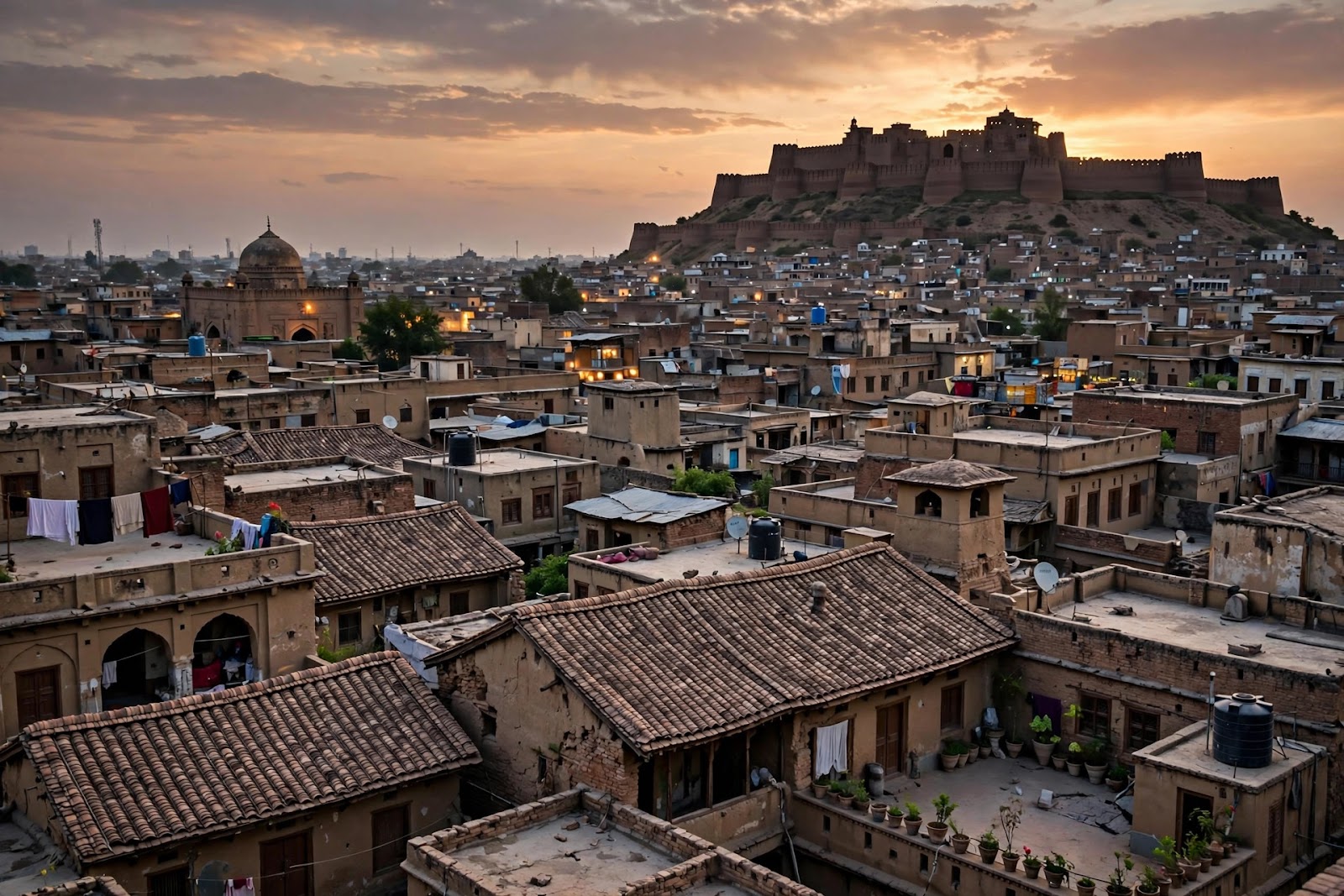
Geographically, KP shares a long border with Afghanistan, making it strategically one of the most sensitive provinces in the country. It has been at the center of Pakistan's security challenges for decades, and its politics have often been distinct from those of the federal capital in Islamabad. In 2018, the former Federally Administered Tribal Areas were merged into KP, significantly expanding the province's territory and population and adding new layers of governance complexity.
Because of its size, its strategic location, and its distinct political character, any change in how KP is governed echoes across the whole country — touching everything from security policy to the balance of power between Islamabad and the provinces.
Why this matters for Pakistan — and beyond
An emergency in a province of more than 40 million people is a national event, not a local one. Here is why analysts, markets, and citizens alike will be watching closely:
- Constitutional precedent. The legality of the proclamation — its grounds, its procedure, and whether parliament approves it — will be scrutinized by lawyers, courts, and opposition parties. Pakistan's history suggests such moments often produce landmark rulings.
- Continuity of governance. Policing, health services, and development projects in KP will now answer to a federally appointed authority. How smoothly that transition works will affect daily life across the province.
- National politics. The relationship between the federal government and the provinces is one of the central fault lines in Pakistani politics. An emergency shifts that balance sharply toward the center.
- Regional attention. Given KP's border with Afghanistan, neighboring countries and international observers will be watching for any security implications.
One important caution: the stated reasons for the emergency had not been publicly detailed in the reports available at the time of writing. Readers should be careful with claims circulating on social media about motives or behind-the-scenes causes — treat those as unverified until credible, on-the-record sources confirm them.
Other top stories today
India condemns attack on Riyadh's King Khalid International Airport
India has condemned the attack on King Khalid International Airport in Riyadh, adding its voice to the international reaction against strikes on civilian aviation infrastructure. The condemnation follows the missile attack on the airport that killed 12 people — the deadliest Gulf strike since the Iran war, which we covered in detail in our detailed coverage of the Riyadh airport missile attack. Attacks on airports and civilian facilities draw condemnation across political lines because of the danger to passengers, crew, and airport workers; governments generally treat them as particularly serious escalations.
109 migrants dead, 116 missing after boat capsizes off Djibouti
In one of the worst maritime tragedies of the year, a boat carrying migrants capsized off the coast of Djibouti: 109 people were killed and 116 are missing, according to United Nations figures. The Horn of Africa remains one of the world's most dangerous migration corridors, with thousands attempting the Gulf of Aden crossing toward the Arabian Peninsula each year in overcrowded, unseaworthy vessels. Search and rescue operations are continuing, and the large number of missing means the final death toll could rise further. The UN and humanitarian agencies have repeatedly warned that without safe, legal migration pathways, tragedies like this will keep happening.
Trump says Putin wants a settlement; claims Russia–Ukraine energy ceasefire
On the Ukraine war, US President Donald Trump said that Russian President Vladimir Putin "would like to see a settlement" — a remark that will be parsed carefully by diplomats watching for any genuine opening. Trump also said that Russia and Ukraine have agreed to an energy ceasefire, a claim reported by BitRss roughly seven hours before 08:00 PKT on October 12. That second claim should be treated as developing and unconfirmed until it is verified by the parties themselves or by neutral observers. It is worth remembering the backdrop: Trump's recent dealings with Moscow have already been contentious, as seen in the controversy over Trump's Russian diesel deal.
Energy infrastructure has been a repeated target throughout the war, and any genuine pause in strikes on energy facilities would matter enormously for civilians heading into winter. But announced ceasefires in this conflict have a history of collapsing quickly — so verification matters far more than announcements.
What to watch next
- Official confirmation from Islamabad. The exact text of the emergency proclamation — its legal basis, duration, and the administrative setup for KP — is the single most important missing piece of this story.
- Parliamentary and judicial response. Whether the proclamation is placed before parliament, and whether it faces legal challenge, will determine how long it stands.
- Reaction from KP's political leadership. Statements from the dissolved provincial government's leaders will shape the political narrative in the days ahead.
- The Riyadh investigation. Further details on the airport attack inquiry and additional international responses beyond India's condemnation.
- Djibouti rescue updates. The figure of 116 missing may change as search operations continue.
- The Ukraine energy claim. Independent confirmation — or denial — of the reported energy ceasefire from Moscow and Kyiv.
This is a developing story. We will update our coverage as confirmed information becomes available — keep following The Global Spy for the latest.