

For fifteen years, Amazon's Fire tablets were the cheap, cheerful underdogs of the tablet world. They ran Amazon's restricted Fire OS and sold largely because they were almost free at checkout. This October, Amazon killed the Fire tablet line entirely and replaced it with a premium, AI-first family called Alexa tablets. The new lineup starts at $230, goes on sale October 14 in the US, Mexico, and Canada (October 19 in the UK, Germany, France, Italy, and Spain), and aims squarely at the iPad and Samsung's Galaxy Tab line.
This is the biggest strategic shift Amazon has made in consumer hardware in a decade — and it says a lot about where tablets and AI are heading.
Goodbye, Fire: The End of a 15-Year Era
The Fire tablet era began in 2011 with the original Kindle Fire. Amazon's playbook was simple: sell the hardware at near-cost, then make money on Prime subscriptions, Kindle books, video streaming, and app purchases. The tablets were made of cheap plastic, their Fire OS lacked the Google Play Store, and apps like YouTube, Gmail, and Snapchat often had to be sideloaded through unofficial workarounds. For many owners, that was fine — the tablets were disposable-priced screens for kids, kitchens, and nightstands.
But cheap had limits. Amazon is phasing out Fire tablets because they no longer give customers what they want: a tablet that runs the apps they actually use. Amazon will stop shipping Fire tablets in the coming weeks and will support existing devices for at least four years from their last ship date. The Alexa tablets, by contrast, are an all-new product line with new hardware and a new operating system — not simply rebranded Fires.
Meet the Lineup: Alexa Tablet 8, 11, and 12 Pro
Amazon is launching three models at once, each with a clear job:
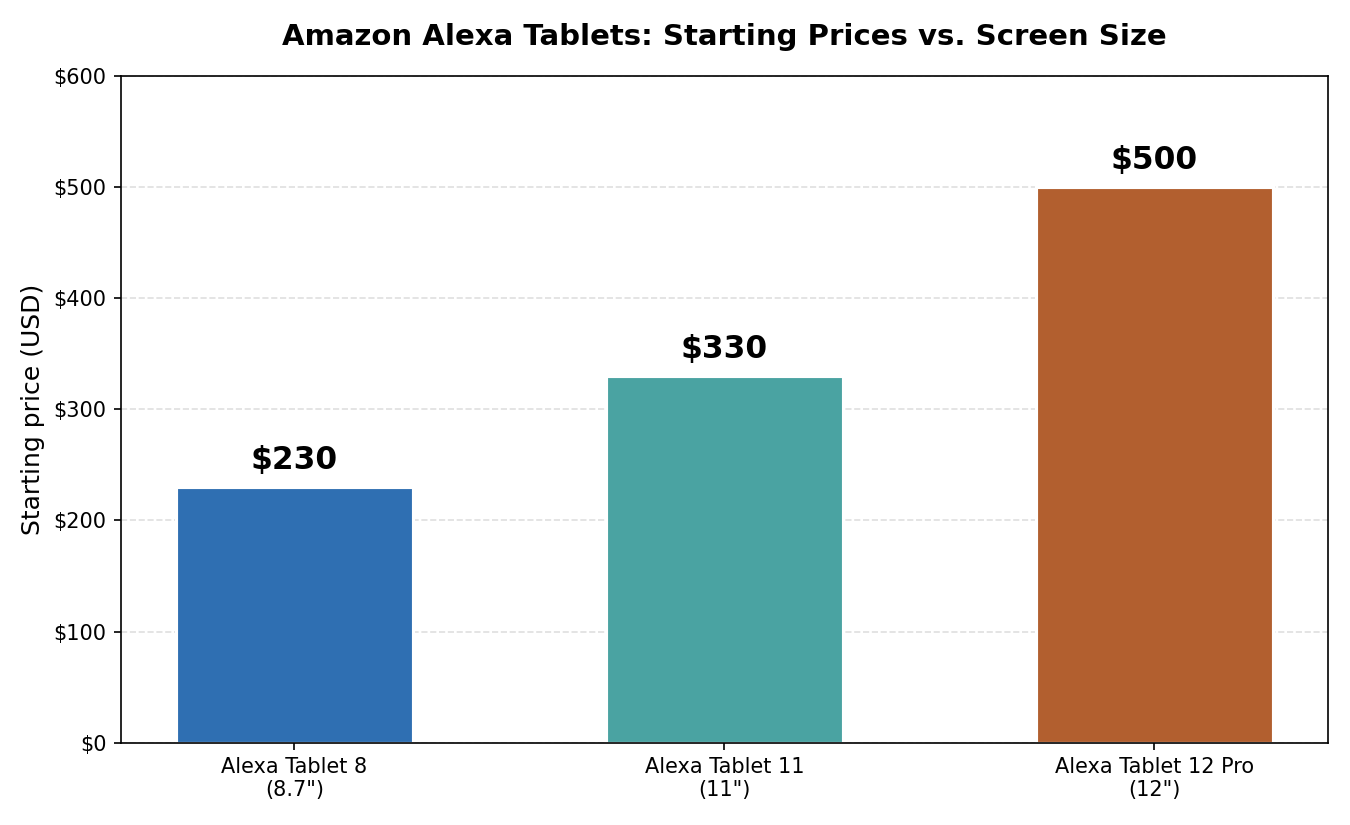
Alexa Tablet 8 — $230. The compact entertainment model. It has an 8.7-inch display, an 8-core CPU, a 2-core GPU, 4GB of RAM, and 64GB or 128GB of storage. It is 0.3 inches thick and weighs just 16.4 ounces, making it the most portable of the three. Amazon rates it for up to 14 hours of video playback and 19 hours of Kindle reading on a charge.
Alexa Tablet 11 — $330. The mid-range step-up. It carries an 11-inch 2.5K display with a 90Hz refresh rate and a cinematic 16:10 aspect ratio, an 8-core CPU, a fifth-generation MDLA NPU for on-device AI processing, 8GB of RAM, the same 64GB/128GB storage options, dual Dolby Atmos speakers, and a fingerprint sensor. Battery life tops out at 15 hours of video playback, according to Amazon.
Alexa Tablet 12 Pro — $500. The flagship and the real iPad competitor. A 12-inch display at 280 pixels per inch, a 120Hz refresh rate, a productivity-friendly 3:2 aspect ratio, an 8-core CPU, a 7-core GPU, an eighth-generation MDLA NPU, 8GB of RAM, and 128GB of storage. Amazon claims up to 16 hours of video playback and 20 hours of Kindle reading. It also has a fingerprint sensor, and Amazon offers a Nanomatte anti-glare display option for an extra $50.
Head-to-head comparison
| Feature | Alexa Tablet 8 | Alexa Tablet 11 | Alexa Tablet 12 Pro |
|---|---|---|---|
| Display | 8.7" | 11" 2.5K, 90Hz, 16:10 | 12", 280 PPI, 120Hz, 3:2 |
| CPU | 8-core | 8-core | 8-core |
| GPU | 2-core | — | 7-core |
| AI chip (MDLA NPU) | — | 5th generation | 8th generation |
| RAM | 4GB | 8GB | 8GB |
| Storage | 64GB / 128GB | 64GB / 128GB | 128GB |
| Speakers | — | Dual Dolby Atmos | Dolby Atmos (up to quad) |
| Battery (claimed) | 14h video / 19h Kindle | 15h video | 16h video / 20h Kindle |
| Thickness / weight | 0.3", 16.4 oz | — | — |
| Fingerprint sensor | No | Yes | Yes |
| Starting price | $230 | $330 | $500 |

Kids' editions of the 8 and 11 are also available at the same prices, with bumper cases, a one-year worry-free replacement guarantee, and a year of Amazon Kids+.
Why Is Amazon Going Premium? The Strategy Behind the Shift
This move deserves a closer look, because it reverses Amazon's entire hardware philosophy. Three forces explain it:
1. AI is now the product. Every device in the lineup ships with Alexa+ — Amazon's generative-AI assistant — built in. Amazon isn't selling tablets; it's selling screens for its AI. On-device neural processors let the assistant respond faster and work offline for basic tasks, while deeper cloud models handle the heavy lifting. Amazon needs hardware worthy of Alexa+, and a $60 plastic tablet with a sluggish chip would have cheapened its flagship AI. As our explainer on OpenAI's GPT-6 intelligent interface shows, these assistants are evolving fast — and Amazon wants to compete at the hardware level too.
2. The app problem finally got fixed. The single biggest complaint about Fire tablets was the lack of the Google Play Store. The new Alexa tablets run standard Android with full Google Play access — YouTube, Gmail, Maps, Netflix, Snapchat, Reddit, and Slack all install natively, with no sideloading. That one change turns the tablets into credible daily drivers instead of walled-garden side devices — and puts Amazon in direct comparison with iPads and Galaxy Tabs, right where it wants to be.
3. The competition moved upscale. Apple and Samsung dominate the mid-range and premium tablet space. Meanwhile, Amazon's low-end advantage eroded as budget Android tablets got cheaper and better. The only way to grow was upward: premium aluminum bodies, high-refresh displays, dedicated AI silicon, and ecosystem perks as differentiators. The smart-home angle matters too — as our recap of Apple's Welcome Home event announcements showed, every tech giant is building its AI strategy around the home, and the tablet is the natural command center.
What the MDLA NPU Actually Means for You
"MDLA NPU" is Amazon's name for its in-house neural processing unit — a dedicated chip for AI tasks, built right into the device. Here's what that means in plain terms.
An NPU handles machine-learning workloads — voice recognition, photo enhancement, live translation — without waking the main CPU or sending data to the cloud. The practical benefits: faster responses (no network round-trip), lower power draw during AI tasks, and more privacy, because sensitive inputs like your voice or what is on your screen can be processed locally.
Amazon's On-Screen Intelligence is the showcase: Alexa can read and act on what's on your tablet — summarize an article, add a date to your calendar, identify a product in a photo. Amazon says this capability is off by default, requires you to turn it on, and shows a visual indicator whenever Alexa can see the screen. That opt-in design matters for a device Amazon is positioning as a family and kitchen tablet.
The fifth-gen chip in the Tablet 11 handles everyday AI tasks; the eighth-gen chip in the 12 Pro is built for heavier workloads and future features. Amazon's headline claim — that the 12 Pro delivers "three times faster processing and nine times faster graphics" than any tablet it has previously shipped — is exactly that: a company claim. Until independent reviewers run real benchmarks, treat it as marketing until proven.
This is part of a bigger trend of AI moving into everyday hardware — the same month Amazon killed the Fire, devices like the Natura Interface 99 AI smart ring packed AI onto a finger. The tablet is the next, bigger canvas for on-device intelligence.
Which Model Is Right for You?
Choose the Alexa Tablet 8 if: you want a light, affordable tablet for reading, video, and kids. At 16.4 ounces it is the travel-and-bedside pick, and the 19-hour Kindle reading claim makes it a strong e-reader upgrade.
Choose the Alexa Tablet 11 if: you want the best value. For $100 more than the 8, you get double the RAM, a sharper 2.5K 90Hz screen, Dolby Atmos speakers, a fingerprint sensor, and the first tier of on-device AI silicon. For most buyers, this is the sweet spot.
Choose the Alexa Tablet 12 Pro if: you want a laptop-adjacent work tablet. The 3:2 display is made for documents and web pages, the 120Hz refresh makes everything feel fluid, and the 8th-gen NPU plus 7-core GPU aim at creators and power users. The Nanomatte upgrade is worth considering if you work near windows.
Honest Caveats Before You Preorder
But here is what to keep in mind before you preorder:
- Performance claims are unverified. The "3x faster / 9x faster" numbers are Amazon's own claims, and no independent reviewer has published benchmarks yet. Wait for hands-on testing before taking them at face value.
- Ecosystem lock-in cuts both ways. Google Play access is a huge win, but these tablets still orbit Amazon's ecosystem — Alexa+, Kindle mode, Kids+. If you're not a Prime member, check what Alexa+ actually offers you before buying for the assistant alone.
- The fine print costs money. Retail reports say the $230 and $330 prices include lockscreen ads, which cost $20 to remove. The Nanomatte display, keyboard, and pen are all extras.
- Privacy is a setting, not a guarantee. On-Screen Intelligence is opt-in with a visual indicator, which is the right design — but review the privacy settings yourself when the device arrives.
- Fire tablet owners: Amazon promises four years of support from the last ship date, so your device isn't dead tomorrow. But the platform direction is clear — future apps and Alexa+ features will target the new line.

Release Dates and Pricing at a Glance
- October 14: on sale in the US, Mexico, and Canada. Preorders are open now.
- October 19: on sale in the UK, Germany, France, Italy, and Spain.
- Prices: Alexa Tablet 8 from $230 · Alexa Tablet 11 from $330 · Alexa Tablet 12 Pro from $500 (Nanomatte version $550).
- The new tablets launch with Android 16 and are promised at least four years of software updates.
The Bigger Picture
The Fire tablet was one of tech's longest-running bargains — a device Amazon practically gave away to pull you into its store. Its death marks the end of the race-to-the-bottom era in tablets and the start of something new: tablets as AI devices first, media screens second. Whether Amazon can sell premium hardware at iPad-adjacent prices comes down to two things no press release can settle — how good Alexa+ really is, and whether reviewers confirm the performance claims.
The tablet market just got more interesting. For fifteen years, Amazon's tablets were the thing you bought because they were cheap. Now Amazon wants you to buy them because they're good — a much harder sell, and a much more fun one to watch.