

A Chance Discovery in Oxford
Sometimes the biggest scientific surprises arrive by accident. That is reportedly what happened recently in Oxford, where researchers stumbled upon a tiny single-celled organism — a protist — whose DNA plays by a different set of rules than almost all other known life on Earth.
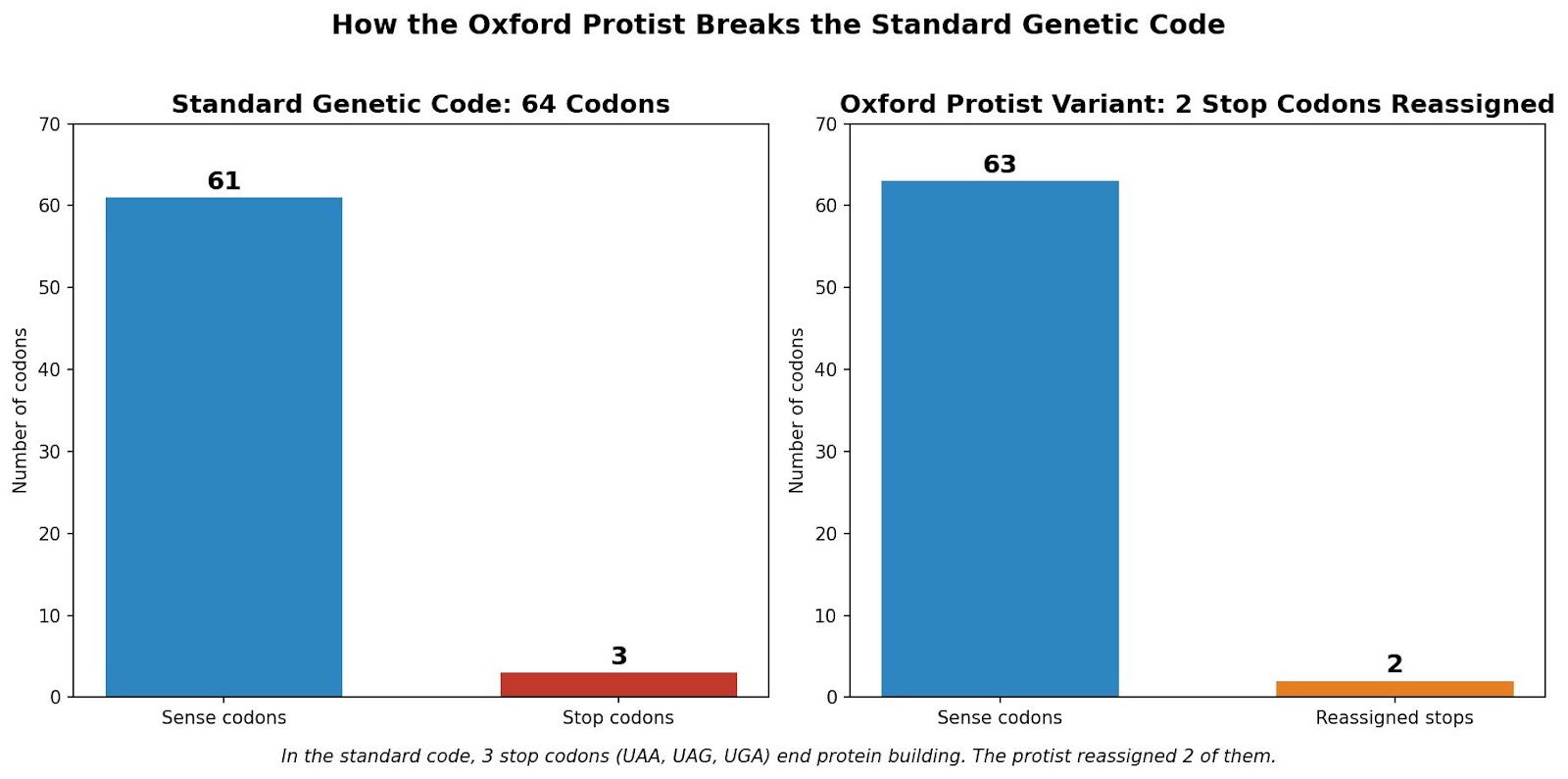
The details, as reported this week, are striking: this protist carries a genetic code in which two of the three stop codons have been reassigned. In plain terms, two of the three signals that tell cells "stop building this protein here" now appear to mean something else entirely. If confirmed, it would be one of the most dramatic deviations from the standard genetic code ever found — and researchers say it could have significant implications for how we understand the origins of life itself.
The scientific community has reportedly reacted with genuine excitement, and the discovery's full impact is still being assessed. Further research will be needed before anyone knows exactly what this organism is doing and how. But even at this early stage, the story is a perfect window into one of biology's deepest questions: how rigid — or how flexible — are the rules of life?
First, What Is the Genetic Code?
To understand why this matters, you need a quick refresher on what the genetic code actually is.
Your DNA is written in an alphabet of just four chemical letters: A, C, G, and T (U replaces T in RNA). Cells read this genetic text in three-letter words called codons. There are 4 × 4 × 4 = 64 possible codons. Sixty-one of them are instructions to add one of the 20 amino acids to a growing protein chain — leucine here, tryptophan there, and so on. The remaining three — UAA, UAG, and UGA — are stop codons. They are the punctuation marks of genetics: full stops that tell the cell's protein-building machinery, "this protein is finished; let go."
This system is what translates the information in your genes into the proteins that build and run your body. Change a codon assignment and you change how every protein in the cell gets built. That is why, for decades, the genetic code was treated as something close to untouchable — a universal standard shared, with only tiny exceptions, by every bacterium, plant, fungus, and animal on the planet, including you.
Why Scientists Thought the Code Was Near-Universal
The universality of the genetic code is one of the strongest pieces of evidence that all life on Earth descends from a common ancestor. The reasoning is simple: it is extremely unlikely that two unrelated lineages would independently arrive at exactly the same 64-codon dictionary by chance. The shared code is like a fingerprint, passed down through roughly four billion years of evolution.
In 1968, Francis Crick — the co-discoverer of DNA's structure — suggested the code might be a "frozen accident": that it settled into its current form very early in life's history and then became locked in place, because by that point changing it would break too many proteins at once. The idea stuck. For half a century, the standard genetic code has been described in textbooks as essentially universal, with scientists fond of calling it one of life's fixed laws.
Science has a long and proud history of venerable ideas finally being put to the test — as with our report on a 95-year-old quantum prediction that was confirmed for the first time. And as it turns out, the genetic code has been quietly bending its own rules for much longer than most people realize.
The Rule-Breakers We Already Knew About
The Oxford protist is not the first organism to tweak the code — which is important context, because it tells us the genetic code is more flexible than the old "frozen accident" story suggested.
Ciliates — the group that includes the well-studied pond microbes Paramecium and Tetrahymena — famously reassign two stop codons, UAA and UAG, to code for the amino acid glutamine instead. Some ciliates even reassign all three stop codons, leaving them with no conventional stop signal at all.
Mitochondria, the energy factories inside your own cells, use their own modified code. In human mitochondria, the codon UGA — a stop codon in the standard code — instead codes for the amino acid tryptophan. Different mitochondria in different species have drifted even further, with some reassigning several codons at once.
Beyond that, there are nuclear-genome variants too: the yeast Candida reads the codon CUG as serine rather than leucine, and some species of the parasite Mycoplasma also turn UGA into tryptophan. Scientists have now catalogued more than thirty alternative genetic codes in nature.
So variants exist. What makes the reported Oxford discovery stand out is the scale: two stop codons reassigned in a single organism places it among the most dramatic known deviations from the standard code. Stop codons are not minor vocabulary choices — they are the punctuation that determines where every protein begins and ends. Reassigning one is like removing a letter from the alphabet; reassigning two is rewriting the grammar.

How Does a Genetic Code Change at All?
If changing the code is so dangerous, how does any organism manage it? Biologists have worked out a few plausible routes, and they help make sense of what the Oxford protist may have done.
The most widely discussed mechanism is called codon capture. Imagine a genome that, by chance, slowly loses all uses of a particular codon — through mutations that swap it for synonyms elsewhere. If the codon disappears from every gene, the cell no longer needs its original meaning. The "slot" becomes free, and a mutation in a transfer RNA molecule can capture it for a new amino acid with no disruption to existing proteins. Once the new meaning spreads, the codon gradually reappears in genes, now carrying its new assignment.
A second idea is the ambiguous intermediate route: a codon briefly carries two meanings at once — read as one amino acid in some proteins and as a stop signal in others — before settling on its new role. This sounds risky, and it is, but in simple organisms with short genes and small protein repertoires, evolution has room to experiment.
Both routes require time and a particular kind of evolutionary pressure. That the Oxford protist apparently took the journey twice — for two separate stop codons — hints at an evolutionary history that was either unusually long, unusually inventive, or both. Working out which is part of what the researchers now have to do.
What This Could Mean for Life's Origins
Here is where the excitement — and the need for care — really begins. Researchers say the discovery could have significant implications for our understanding of how life began, and it is worth spelling out why, without overstating it.
The genetic code is often treated as a window into life's earliest days: because it is shared so widely, it must have taken shape before the major branches of life split apart — very close to the origin itself. If the code was more flexible than we thought, that changes the picture. It suggests that in life's early chapters, the "rules" were more like rough drafts, being tested and rewritten as early cells worked out how to turn genetic information into proteins reliably.
A protist today that runs on a double-reassigned code is not a living fossil from the origin of life — it is a modern organism with a long evolutionary history of its own. But it may show us the kind of flexibility the code once had, and perhaps the kind of processes that shaped the code we inherited. In a sense, it is a reminder that even the most fundamental-seeming features of biology have a history, and that history can still surprise us.
That search for beginnings is one of science's great ongoing quests, across every field — from our story on how CHIME detected hydrogen's glow from billions of years ago to studies of the oldest rocks and the simplest cells. The Oxford protist adds a new and unexpected chapter to it.

What We Still Don't Know — An Honest Caveat
It is important to be honest about where things stand, because the reporting on this discovery is still at an early stage.
This is, so far as reported, a single organism, found by chance. Its species has not been named in the reports, nor have the researchers, the journal, or the exact methods behind the find. The full impact is still being assessed, and — in the researchers' own reported framing — further research is needed. Key questions remain open: which amino acids (if any) do the reassigned codons now encode? How does the protist's protein machinery handle the change? How did it evolve, and is it truly alone, or the first of a family of similar rule-breakers waiting in pond water and soil samples worldwide?
Until independent studies confirm and extend the finding, the right attitude is excitement with patience. Many genuinely strange biological discoveries have started exactly this way — a single odd sample, found by luck — and gone on to reshape textbooks. A few have turned out to be narrower than first reported. Both outcomes advance science.
Why This Story Matters Anyway
Strip away the technical detail, and what you are left with is something profound. One of the most basic facts of biology — the dictionary that translates DNA into life — turns out not to be a law of nature after all, but a habit: a very old, very widely shared habit, but a habit that at least one small cell in Oxford decided to break.
That does not overturn evolution or rewrite biology overnight. But it does remind us of something easy to forget: the "rules of life" were written by life itself, and life has never been much of a rule-follower. The textbooks will be updated, the researchers will dig deeper, and somewhere out there — perhaps in a puddle, a patch of soil, or a lab sample not yet opened — there may be more exceptions waiting to be found by chance.