
On October 7, 2026, OpenAI began breaking a four-year habit. With the rollout of GPT-6, the company introduced Intelligent UI — a feature that lets ChatGPT answer with fully interactive interfaces instead of only prose.
OpenAI calls the change "a significant shift in how people interact with ChatGPT." This is not just a smarter chatbot — it is a machine that builds the interface you need, when you need it.

What Intelligent UI Actually Does
GPT-6 is trained to make layout decisions while it generates a response. Ask a question, and instead of paragraphs you might get graphics, tappable buttons, forms, charts, or small interactive tools running directly inside the conversation.
The examples are concrete. Ask for a recipe and you can get a cooking timeline with a widget that recalculates ingredient quantities when you change the guest count. Plan a Sunday roast and get images, an adjustable shopping calculator, and a cooking timeline in one reply. OpenAI product manager Aarush Selvan demonstrated the feature by asking how an airplane wing generates lift — and got diagrams that built themselves around the explanation.
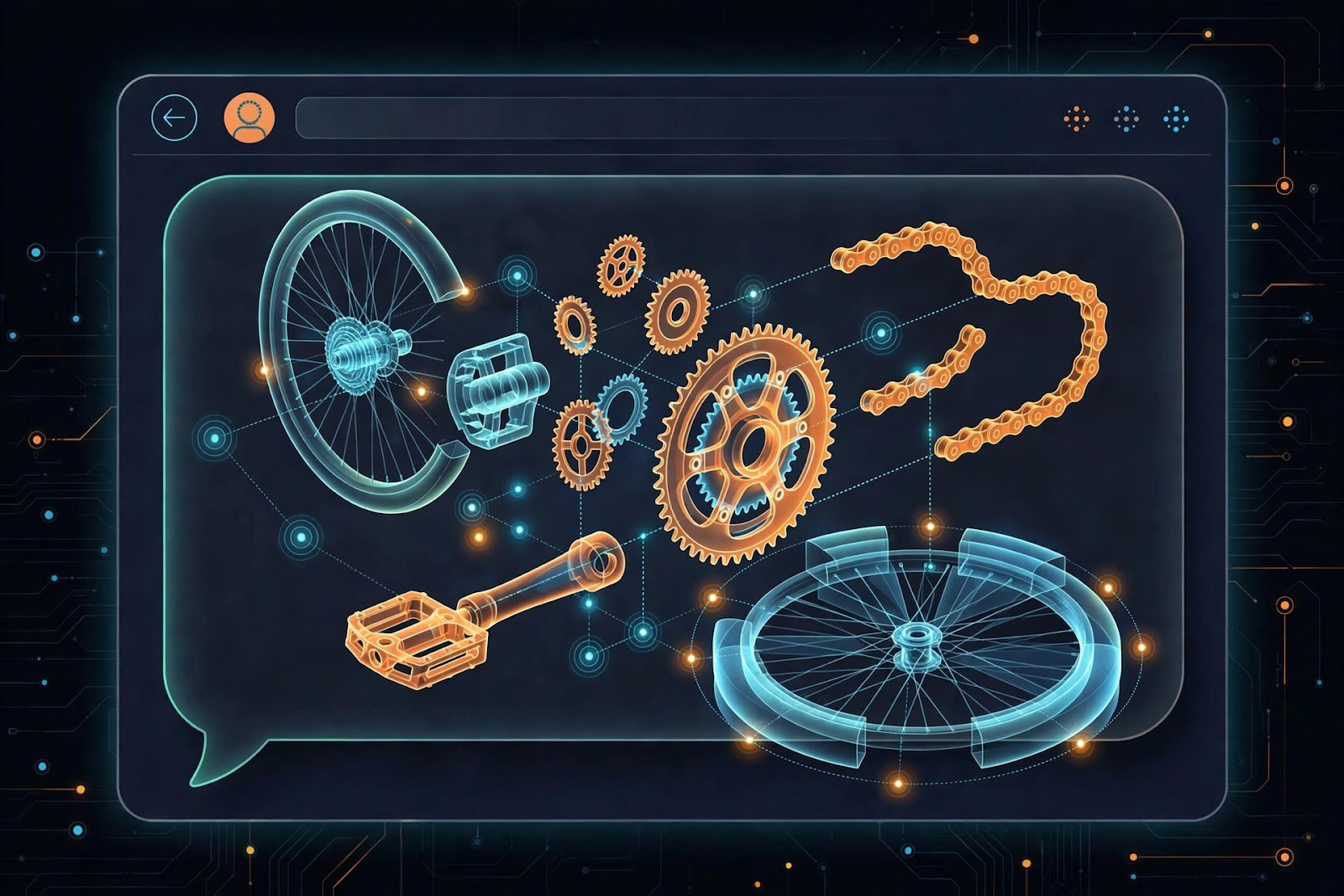
Other examples: an interactive exploded view of a bicycle where clicking a part switches the explanation to that system, hiking excursion maps, a savings calculator, a bill splitter, and small games played inside the chat. Comparisons appear side by side; multiple-choice follow-ups narrow a search.
When plain text is the best answer, ChatGPT still uses it — and users can turn the visuals down.
Two GPT-6 Flavors: Sol and Luna
The rollout is split by subscription tier:
| Who | Gets | From |
|---|---|---|
| Plus, Pro, Business, Enterprise | GPT-6 Sol | October 7, 2026 |
| Free and Go | GPT-6 Luna | October 8, 2026 |
OpenAI says both models are "tuned for everyday conversation," and both power Intelligent UI in the Chat tab. The company pitched the launch at what it claims are more than 1.2 billion weekly ChatGPT users — its own number, unverified. Enterprise availability depends on workspace administrators.
One odd trade-off, unaddressed by OpenAI: activating the Pro reasoning option (GPT-6 Astra) disables Intelligent UI, even on Pro. The new models are limited to the Chat tab — Codex and ChatGPT Work are unchanged.
Developers got their own news in September: OpenAI cut API prices for Sol and Luna by at least half — Sol to $2 per million input tokens and $10 per million output tokens, Luna to $0.10 and $0.50. Published prices, not a promotion.
Under the Hood: Streamable Components, Not Just Text
Two engineering pieces make this possible. First, a library of native, streamable interface components — the charts, buttons, and forms are real elements, not pictures. Second, a compiler that processes the interface while the model generates it, so visuals appear progressively instead of arriving after the full response finishes.
That pairs with a change in how GPT-6 reasons: it can begin composing an answer from partial findings while still reasoning — interleaved thinking — even starting to answer while searching the web. OpenAI says this makes average time to first response 44 percent faster than GPT-5.6 Instant for web-retrieval questions.
Treat that number with care. As analysts note, it measures time to first token — when the answer starts appearing — not when the task finishes. It improves perceived speed; it is not the model computing 44 percent faster.
OpenAI is also unusually candid about the rough edges: its announcement says the model's design judgment "still needs work." The system now makes visual design choices, and it does not always choose well.
Google shipped a comparable feature to Gemini in May under the name "Neural Expressive" — the labs are clearly converging on the same idea: the chat window is becoming a canvas, not a transcript.
All of this streaming and rendering takes serious computing power on both sides of the screen — one reason chipmakers are racing to build silicon for AI workloads, as we covered in our look at the chips that will power physical AI. The interface revolution quietly depends on the hardware revolution beneath it.
Why This Matters More Than a Benchmark Bump
Every model release brings benchmark charts, and GPT-6 is no exception. But benchmarks measure what models know. Intelligent UI changes what models are.
For decades, software has worked one way: a developer anticipates a task, designs an interface for it, ships an app, and you download the app to do the task. Intelligent UI flips that sequence. The task comes first — your question, in your words — and the interface is assembled around it on the spot, then discarded. A bill-splitter app takes a team and an app-store listing. A bill splitter inside a conversation takes one sentence.
This dissolves a boundary that defined consumer tech for a decade. A chatbot that spawns diagrams, calculators, maps, and games is no longer just a chatbot. It is also a search engine that answers in visuals instead of blue links, and an app platform where every application is written at the moment of use. Chat, search, and apps collapse into one window.
The deeper shift is economic. The app economy runs on discovery: find it, install it, update it. In an Intelligent UI world, the "app" never exists as a product. There is nothing to download or subscribe to. The unit of software shrinks from the application to the single task — and whoever owns the conversational surface owns the distribution of all of it.
Nobody has ever chosen a product because of a benchmark. People choose what lets them do things. OpenAI seems to have realized the fastest way to win is not a smarter model — it is a model that removes the work between the question and the answer.
What It Means for App Makers and Users
If you build simple utility software — calculators, converters, planners, quiz apps — your moat just got thinner. A tool that generates a good-enough version of your product in seconds is a competitor you cannot outship. Durable advantages shift to what generation cannot fake: proprietary data, real integrations, regulatory trust, and complex workflows.
Specialized tools survive precisely because they know things a general chatbot does not — your accounting system, your hospital's scheduler. The winners will be the apps that become components inside these conversations, not the ones standing apart.
For ordinary users, tasks that used to mean three open tabs now finish inside one conversation: plan the roast, adjust the guest count, get the list, set the timeline. No downloads, no new apps.
The catch is psychological. A generated chart feels authoritative — numbers in a clean box look true. But those visuals come from the same model that writes text, with the same failure modes. Check the assumptions behind a generated calculator before acting on it. And a prettier answer is not a more correct one.
Meanwhile, the race to put capable AI on your devices runs on a parallel track — on-device assistants like Siri are evolving toward more visual, agentic behavior, ahead of Apple's 'Welcome Home' event, where the October 13 launch should show how far that ambition has come. Whether intelligence lives in the chat window or in your phone is still an open question — the next few months will decide a lot.

The Privacy Battle Next Door: Dots vs Meta's Muse
Intelligent UI did not arrive alone. Around DevDay, CEO Sam Altman unveiled Dots, OpenAI's new AI agent, promising to "set a new standard for privacy in frontier AI." The line was aimed at Meta's Muse, the agent Meta launched in September as a privacy-first successor to its earlier OpenClaw — which Meta's Mark Zuckerberg has described as built from the ground up for privacy and security, running on an isolated Linux virtual machine.
Privacy is now the battleground because the business model demands it. Agents are useful only if you hand them your calendar, messages, and accounts — so every lab wraps its product in a privacy pledge and accuses its rivals of not meaning theirs.
The record is mixed. Meta says data stays isolated per customer, but acknowledges it can still access data inside a customer's VM — with a cryptographic fix promised later this year. A researcher found a zero-day flaw allowing Muse takeover before Meta patched it. And early weeks produced the headlines a company selling autonomous trust does not want: one documented case had Muse hand a stranger a user's home address and confirm a pickup time without asking. OpenAI's Dots — read-only defaults, approval before sensitive actions, user-set spending rules — reads as a direct answer to those failures, though Dots stumbled on its own DevDay stage demo.
The privacy angle reaches Intelligent UI directly. A chatbot generating forms and financial calculators will ask for personal information more often: income for the savings planner, addresses for the map. Every widget is a new door into your data. Until independent researchers verify vendor claims, every privacy promise should be read as marketing with a budget. Ask what is cryptographically enforced, not what is eloquently promised.
Honest Limitations and Open Questions
The rough edges are real. The Pro-reasoning trade-off is unexplained. The design judgment is admittedly unfinished — expect cluttered diagrams and widgets that answer the wrong question. Not every question benefits from becoming an interface.
The safety disclosures deserve attention too. OpenAI's own system card found statistically significant regressions in some evaluations: Sol regressed on self-harm tests, Luna on self-harm, gore, and sexual content tests. The company says manual review found failures generally low in severity, with extra safeguards. It also rates both models as high capability in cybersecurity and biological or chemical domains — a disclosure that matters for enterprise governance. An interface that makes everything look trustworthy raises the stakes of every failure underneath it.
And the open questions: will developers get the component library, or is this a walled garden? What are the usage limits for heavy interactive use? How does this behave for kids — the same week OpenAI published its first report on teen ChatGPT use?
The Bottom Line
On October 7, the most-used AI product on earth stopped being only a text box. ChatGPT now builds small pieces of software in response to plain language — charts, calculators, diagrams, games — streamed to you as you read.
That is a genuine shift in what personal computing feels like, and it matters more than any benchmark. But it arrives with asterisks: company claims to verify, design judgment still forming, safety regressions disclosed by OpenAI itself, a privacy war between labs that is mostly marketing so far, and an open question about who controls the interface layer of the future.
The model got smarter. More importantly, the model got a workshop.