

On October 26, 2026, Hyundai Motor India Ltd (HMIL) will launch the India-spec BAYON — and the company has already given the headline away. This is not another facelift. The Bayon is being positioned as an "intelligent utility vehicle," and its centerpiece is something no Hyundai in India has ever carried: a generative AI voice assistant, combining Perplexity's AI intelligence with SoundHound AI's voice technology.
In-car voice control has been around for a decade, and most of it is terrible. If you have ever shouted "navigate home" at a dashboard only to be told "I did not understand," you know the frustration. The Bayon promises to end that era — not with a better list of fixed commands, but with an assistant that holds a conversation.
This is a launch preview: what Hyundai has confirmed, what the technology actually does, and why generative AI voice has become the car industry's newest and fiercest battleground.
What Hyundai Has Confirmed So Far
Hyundai Motor India unveiled the India-spec Bayon ahead of its October 26, 2026 launch. Here is everything the company has officially put on the table:
- India's first generative AI voice assistant from Hyundai, combining Perplexity's AI intelligence with SoundHound AI's voice technology.
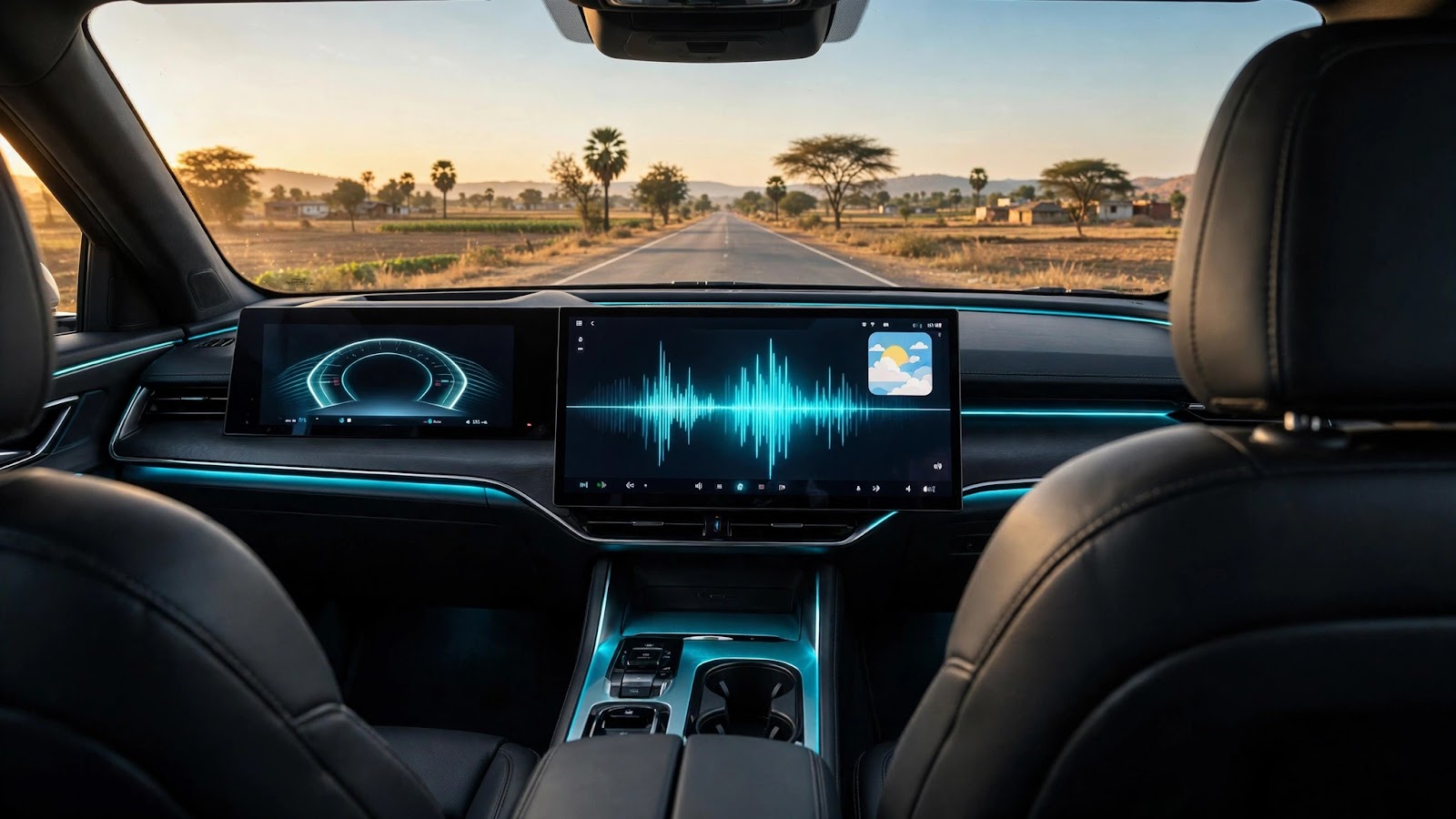
- Conversational capability, not scripted commands: the assistant understands natural spoken requests and can help plan road trips, give weather updates, find hotels and restaurants, locate shopping centers, and report sports scores.
- NVIDIA-accelerated Connected Car Navigation Cockpit (ccNC) — the computing backbone behind the infotainment and navigation experience.
- Over-the-air (OTA) software updates spanning up to 19 vehicle controllers, meaning the car can gain new features and fixes without a dealership visit.
- Bookings are open at authorized Hyundai dealerships and through the company's website, at a booking amount of ₹11,000. Deliveries are planned during the festive season.
Notice what Hyundai led with: not horsepower, not mileage, not a touchscreen size — intelligence. That ordering is deliberate, and it tells you where the industry's center of gravity has moved.
What a "Generative AI Voice Assistant" Actually Means
Conventional in-car voice systems work like a vending machine: say the exact phrase they expect, or the machine jams.
A generative AI voice assistant works more like a conversation with a knowledgeable co-driver. Perplexity brings large-language-model reasoning to the system, so it can parse intent from messy, real-world speech. SoundHound AI brings the voice layer — the speech recognition and natural-language understanding tuned for noisy cabins, accents, and interruptions.
The practical difference shows up in the examples Hyundai gave. Planning a road trip is not one command; it is a chain of linked questions: Where should we stop for lunch? Find a hotel near the highway that has parking. What is the weather like at our destination? Any good shopping centers on the way? A scripted system treats each of those as an isolated transaction. A generative assistant keeps context across the whole exchange — it remembers the route you are discussing and the city you mean.
This is the same shift that turned chatbots into something genuinely useful on phones and computers, now migrating to the dashboard. As we explored in our explainer on how AI interfaces are becoming adaptive, the interface is no longer a fixed menu you learn — it is a system that learns you. A car that remembers your favorite dhaba on the Delhi–Jaipur highway is simply that idea, bolted to four wheels.
Perplexity + SoundHound: Why the Partnership Matters
Hyundai did not build this assistant alone, and the two names it chose reveal the strategy. SoundHound AI is a specialist in conversational voice for vehicles — it already powers voice systems for several automakers and understands the brutal constraints of in-cabin audio: road noise, wind, music, children arguing in the back seat. Voice technology is the "ears," and ears matter enormously when the microphone is competing with a highway.
Perplexity supplies the "brain" — the generative AI that answers the questions rather than just routing them. Perplexity built its reputation on answer engines that combine web-scale knowledge with conversational fluency, which maps neatly onto a driver's needs: What's the score? Is this restaurant still open? Will it rain this weekend? These are not car functions. They are life questions asked at 100 km/h, and they demand a general-purpose intelligence, not an automotive menu tree.

The pairing also signals where value now sits in the auto industry. Hyundai is not trying to out-Google Google on AI; it is assembling best-of-breed partners the way phone makers assemble camera suppliers. The car becomes a platform.
Beyond the Voice: NVIDIA ccNC and 19 OTA Controllers
The voice assistant is the headline, but two other confirmed details deserve attention because they are what make the headline possible.
First, the NVIDIA-accelerated Connected Car Navigation Cockpit (ccNC). Generative AI needs serious compute, and a dashboard screen is not a server farm. NVIDIA's automotive platforms are designed to run exactly this kind of workload — large language models, rich graphics, real-time navigation — inside the vehicle with acceptable latency and power draw. Without that silicon, a "generative AI assistant" would be a cloud demo that stutters every time the network dips. The chip in the Bayon is the reason the conversation can feel instant, which is in line with the new generation of chips being built specifically to power physical AI.
Second, OTA updates across up to 19 vehicle controllers. This is the quiet revolution. Traditionally, a car's software was frozen at the factory; a bug or a missing feature meant a service-center visit — or nothing at all. Nineteen updatable controllers means the Bayon's behavior can evolve after you buy it: a smarter assistant next year, a refined navigation experience, bug fixes pushed silently overnight. It also means the generative AI layer can improve without a model-year refresh, which matters because AI capabilities are moving on monthly cycles while car platforms move on multi-year ones.
Together, the three pieces — conversational AI, in-vehicle compute, and broad OTA reach — form the template of the modern software-defined car. Hyundai is simply one of the first to bring that template to this segment in India.
Why Generative AI Voice Is the Industry's Next Battleground
Look past the Bayon for a moment and the bigger picture comes into focus. Every major automaker is racing toward the same destination, and voice is the road they are all paving.
The safety argument is real. Distracted driving kills. Every glance at a touchscreen is a glance away from the road. A voice assistant that genuinely understands you is not a luxury feature — it is a safety feature, because it is the only interface that keeps your hands on the wheel and your eyes forward. A frustrating system sends drivers back to the touchscreen; a fluent one keeps their eyes on the road.
The moat is the relationship. Cars are purchased every five to eight years, but voice assistants are used daily. Whoever owns the in-car conversation owns a persistent, trusted relationship with the driver — one that can eventually surface paid services, navigation partnerships, and commerce. That is why tech giants and automakers alike are fighting for the dashboard: it is the last great unconquered screen, and voice is its keyboard.
Trust will decide the winners. A conversational assistant that hallucinates — confidently inventing a hotel that does not exist, or mishearing a medical question — is worse than a dumb one. This is the same trust problem facing conversational AI everywhere, from research into automated AI therapy coaches to customer service bots. In a car, the stakes are physical: wrong directions at night, misunderstood emergency requests. Hyundai's choice of established partners reads as an attempt to borrow credibility while the technology matures — but the real test begins when thousands of Indian drivers start talking to it in Hindi, Hinglish, Tamil, Bengali, and a dozen other tongues.
The gimmick line is thin. History is littered with automotive tech that dazzled in the showroom and died in the driveway: gesture controls nobody used, 3D instrument clusters that gave people headaches, apps for everything. Generative voice avoids that fate only if it becomes boringly reliable — the way power steering did. The Bayon's success will not be measured by launch-day headlines but by whether owners are still talking to their cars a year later, out of habit rather than novelty.
What to Expect on October 26
With the launch set for October 26, 2026, here is what to watch for — and what to be skeptical about.
Expect Hyundai to demonstrate the assistant live, in conversational scenarios: the road-trip planning sequence, the weather-and-scores check, the hotel-and-restaurant search. Watch closely for latency — the pause between your question and the answer — because that is where the NVIDIA compute and the on-device versus cloud balance will show. Also watch which languages and accents are supported at launch; a generative assistant that only understands polished English is a fraction of the product India needs.
Be skeptical of any specification beyond what Hyundai has confirmed. The company has not yet detailed powertrains, variant-wise pricing, or the full feature list — those arrive at launch. Treat pre-launch "leaks" accordingly.
The booking details are straightforward: ₹11,000 reserves your slot at authorized Hyundai dealerships or on the company's website, with deliveries timed for the festive season — the industry's most competitive sales window. That timing tells you Hyundai wants the Bayon in driveways when wallets are open and showrooms are crowded.
The Bottom Line
The Hyundai Bayon is not really a story about a new SUV. It is a story about the moment cars stopped pretending that voice control was a checklist feature and started treating conversation as the primary interface. Perplexity's intelligence, SoundHound's ears, NVIDIA's silicon, and over-the-air updates across 19 controllers — that stack is the car industry's answer to a simple observation: drivers already talk to their phones all day, and the dashboard is overdue for the same upgrade.
Whether the Bayon delivers on the promise is a question for October 26 and the months after. But the direction is unmistakable. The next great car feature is not under the hood. It is in the conversation.
Launching October 26, 2026 — bookings open now at ₹11,000 via authorized Hyundai dealerships and hyundai.com.