
Nothing touched it. No hand pushed it, no wire pulled it, no air current nudged it. Yet in a laboratory on the Japanese island of Okinawa, a solid object roughly a centimeter wide moved — pushed only by the quantum spin of electrons inside a diamond. For the first time in history, scientists have watched a purely quantum effect reach up and shift something at a scale that gravity and human fingers can grasp.
The result, published in Science Advances in early October 2026 by researchers at the Okinawa Institute of Science and Technology (OIST), is being called a landmark in quantum physics. And while the actual movement was absurdly small — about 100 nanometers, roughly a thousandth of the width of a human hair — it represents a jump of eight to nine orders of magnitude over every previous experiment of its kind. For the first time, the quantum world has made its force felt on something big enough that gravity is its dominant feature.
The Experiment: A Diamond, a Levitating Plate, and a Laser
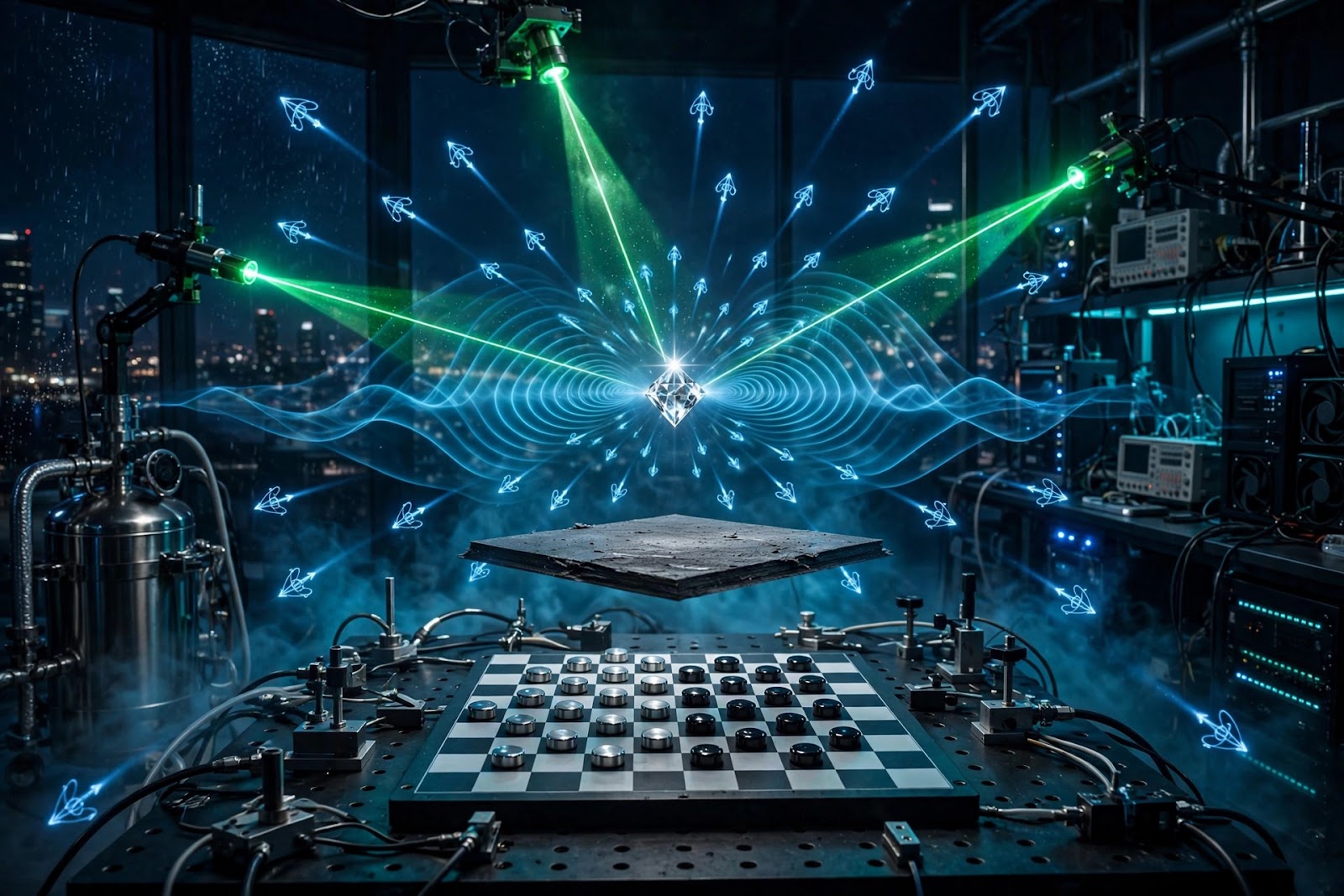
The setup sounds like something from a magic trick, but every piece of it was carefully engineered. The object the team moved was an assembly weighing 128 milligrams — about the weight of a few grains of rice. At its heart was a diamond just 3 millimeters across, but not an ordinary diamond: this one contained special atomic defects known as nitrogen-vacancy (NV) centers. Where a nitrogen atom sits next to an empty spot in the crystal lattice, the diamond's electrons carry a quantum property — spin — that can be precisely controlled with laser light.
The diamond hung from a small plate of graphite. The plate, in turn, floated above a checkerboard of magnets. Graphite is diamagnetic, meaning it is weakly repelled by magnetic fields, so the magnets could levitate the plate without any physical contact. That matters: any contact would transmit vibrations and heat that drown out the faint quantum push, so levitation gave the team a silent stage on which to work.
Here's the sequence. First, the researchers used laser light to manipulate the electron spins inside the diamond's NV centers, aligning and flipping them. Then a second magnet came into play: because a spin has an associated magnetic character, changing the spins altered the magnetic forces acting on the diamond. The assembly shifted — by about 100 nanometers, measured with a highly accurate laser measurement system. When the team compared runs with the laser on against runs with the laser off, the difference was unmistakable: the quantum spins had produced a real, measurable mechanical push.
Wait — What Exactly Is "Spin"?
If you're picturing a tiny ball whizzing around like a top, let go of that image. It's the standard metaphor and it's also, strictly speaking, wrong. In quantum physics, "spin" is an intrinsic property of fundamental particles — more like the particle's electric charge than anything that actually rotates. An electron simply has spin the way it has mass. Physicists call it intrinsic angular momentum, which is a fancy way of saying it behaves, in equations, the way a spinning object would.
Here's a friendlier way to think about it. Imagine each electron as a tiny compass needle that can point one way or the opposite way (spin up or spin down), and never stops "pointing." Quantum mechanics also lets these needles exist in combinations of both directions at once — superposition — and to be linked across particles in ways with no everyday counterpart.
One electron's spin carries essentially no mechanical force at all. But quantum rules allow many spins to be lined up together, and when countless aligned spins change in unison, their individual pushes can add up into something macroscopic. That accumulation — many microscopic compass needles all swinging at once — is exactly what the OIST team exploited. A single raindrop doesn't push you, but a river of them can sweep you off your feet.
How Invisible Spins Shoved Something You Can See
The genius of the experiment lies in three stacked design choices, each solving one of the classic problems of "big quantum" experiments.
1. Isolation through levitation. Large objects are noisy. Everything warm jiggles, every table hums, every breath of air pushes. The team floated their 128-milligram assembly on diamagnetic levitation — the same family of physics that lifts maglev trains — so that no wire, no clamp, no surface transmitted noise into the object. In the silence of levitation, even a whisper of quantum force could be heard.
2. A controllable army of spins. NV diamonds are among the best-understood quantum tools in the world. The nitrogen-vacancy centers in diamond hold their quantum state — including superposition — at room temperature for longer than almost any other system physicists know. That made the diamond's electrons a large, well-disciplined crowd of spins that lasers could choreograph on command.
3. A magnet to translate spin into motion. Spins alone don't push plates; magnets do. The second magnet in the setup acted as a translator: it converted the changed spin state of the electrons into a mechanical force on the diamond. In effect, the quantum property wrote the instruction, and the magnet did the lifting.
Together, these choices pushed the boundary between quantum and classical eight to nine orders of magnitude — that is, roughly a hundred million to a billion times — beyond what previous spin-mechanical experiments had achieved. As the researchers put it, the team is "going from large to small": instead of trying to scale delicate quantum setups upward, they took an object large enough to be firmly in gravity's grip and asked a quantum effect to move it. Nobody had observed that before.
Why 100 Nanometers Is a Huge Deal
One hundred nanometers sounds like nothing. A human hair is about a hundred thousand nanometers thick. So yes, the push was a thousandth of a hair's width — completely invisible to the naked eye, detectable only with precision laser measurement.
But consider the context. Until now, spin-driven movement had only ever been observed in systems millions to billions of times lighter. Each order of magnitude is a factor of ten; jumping eight or nine of them at once is like going from a pebble to a planet. More importantly, 128 milligrams is massive enough that gravity is a significant player in the object's behavior. This is the first time a quantum effect has been observed directly manipulating an object that gravity meaningfully acts upon.
That's why physicists are excited. One of the deepest unanswered questions in science is where the quantum world ends and the classical world begins — and whether gravity itself follows quantum rules. You cannot probe that boundary with particles too light to feel gravity. This experiment built a platform where those profound questions can finally be tested — the same frontier where a 95-year-old quantum prediction was finally confirmed.

What It Isn't (Yet)
Precision matters here, so let's be clear about what this experiment did not do.
First, the movement itself was classical. The object didn't tunnel through a wall or exist in two places at once. A quantum property — the spins — triggered a perfectly ordinary mechanical displacement. The quantum magic was in the cause, not in the motion. The researchers' next goal is the genuinely wild stuff: putting larger objects into superposition, where the object effectively occupies two states simultaneously.
Second, this doesn't give us levitating skateboards or quantum engines. The force produced was fantastically small, and the whole point of the experiment was to isolate the object from the world — the opposite of a useful machine. Its value is as a scientific instrument and a milestone, not a product.
Third, there's an enormous distance between "quantum spins nudged a plate" and Schrödinger's famous thought experiment made real — a cat, or any everyday object, existing in superposition. The team's own framing is ambitious but honest: each order of magnitude they gain brings the quantum-classical boundary closer to observation, and sensors of unprecedented precision may emerge along the way. We are watching the first step of a staircase, not the arrival.
Why It Matters: Sensors, Schrödinger's Cat, and Gravity Itself
So why should anyone outside physics care? Three reasons.
New sensors of extraordinary precision. The techniques that detected a 100-nanometer push can be developed into force and field sensors far beyond today's limits — devices that "listen" at the quantum level, with applications from medical imaging to navigation without GPS. The team describes them as "a new class of extremely precise sensors." New precision instruments keep opening windows on the previously invisible, from forces here on Earth to the CHIME radio array's detection of hydrogen's faint glow from the early universe.

Testing the quantum-classical boundary. The most profound open question in physics may be whether gravity is quantum or entirely classical. If larger objects can be coaxed into superposition, physicists can run experiments where quantum mechanics meets Einstein's general relativity — a real-life version of Schrödinger's cat. It's a tradition of invisible properties shaping the visible world: this year's Nobel Prize in chemistry rewarded work on molecular chirality, another unseen feature of nature with visible consequences.
A platform for exotic physics. By demonstrating a mechanical effect arising solely from quantum spin, the team has created an experimental platform to test theories that today are purely mathematical. Dark matter detectors, tests of whether gravity follows quantum rules, and new ways of thinking about information itself could all eventually run on descendants of this apparatus.
The Bottom Line
For a century, quantum mechanics has been the most successful theory in science — and also the most strangely distant from everyday experience. Its effects powered lasers, transistors, MRI scanners, and quantum computers, yet the phenomena themselves always lived at scales far removed from human touch. The OIST experiment changes the grammar of that story. Nothing touched the object. No force you could feel was applied. And still it moved.
One hundred nanometers is not far. But it is the farthest quantum spin has ever reached into our world — and the first step across a boundary physicists have wanted to cross for a hundred years.
Publication details: Anshuman Nayak et al., "Spin-force from a Nitrogen-Vacancy ensemble drives a 100 mg levitated resonator," Science Advances (2026). DOI: 10.1126/sciadv.aeh0566.
Want more physics breakthroughs? Follow The Global Spy's Science coverage for the biggest discoveries as they happen.