
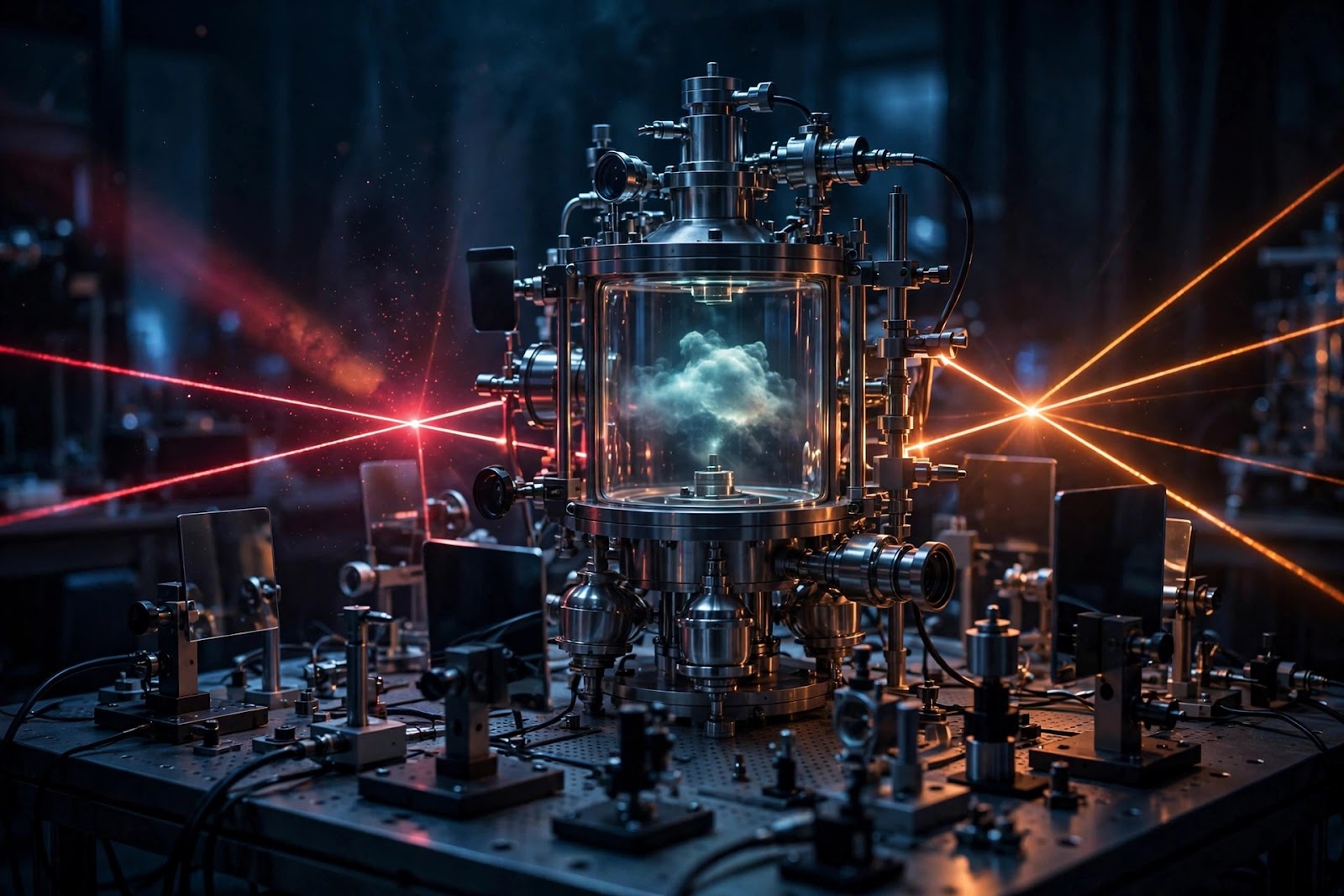
In 1931, a young physicist named Hans Bethe sat down with paper and pencil and solved a puzzle in quantum physics that was, by any measure, astonishing. Working through the mathematics of atoms lined up in a one-dimensional chain, he found that under the right conditions, particles could bind together into strange multi-particle clusters — "strings" of bound particles held together not by chemical bonds but by pure quantum interaction, able to exist only in a single dimension. The math was beautiful. For nearly a century, though, nobody could quite prove the things he predicted were real.
This month, that changed. A team led by quantum physicist Hanns-Christoph Nägerl at the University of Innsbruck, working with theory teams from the University of Amsterdam and the Technical University of Munich, created these elusive states — called Bethe strings — in the laboratory and watched them behave exactly as Bethe's century-old mathematics said they should. Their findings were published in Nature Communications (paper: "Probing Bethe strings in an attractive one-dimensional Bose gas").
It is one of those rare moments when a purely mathematical prophecy, born decades before the technology to test it existed, finally steps out of the equations and into reality.
Who Was Hans Bethe — and What Did He Predict?
Hans Bethe (1906–2005) was one of the towering physicists of the 20th century. He won the 1967 Nobel Prize in Physics for working out the nuclear reactions that power stars — the same fusion physics that makes the Sun shine. It is fitting, in a way, that the man who decoded how stars burn also foresaw one of the subtlest structures in quantum matter; both are stories of bold predictions eventually meeting observation, much like how the James Webb Space Telescope is rewriting our picture of the first billion years.
In 1931, Bethe was tackling a different problem: the one-dimensional Heisenberg model, a theoretical chain of atomic magnets where each magnet interacts only with its immediate neighbors. To solve it, he invented what physicists now call the "Bethe ansatz" — a clever mathematical technique for writing down the quantum states of many interacting particles at once. Hidden inside the solution was something nobody expected: special solutions in which several particles bind together into a single composite object.
Here is the key idea in plain terms. Imagine a long line of atoms, each able to carry a ripple of magnetic energy (physicists call these ripples "magnons"). Normally those ripples wander independently. But Bethe showed that in one dimension, with the right kind of attraction between particles, several ripples can stick together and travel as one unit — a bound cluster. Physicists later called this the "string hypothesis": in the abstract space where the solutions live, these bound states arrange themselves like beads on a thread. Hence the name: strings.
Crucially, Bethe strings are not molecules. A water molecule is held together by shared electrons — chemical bonds. A Bethe string has no such bonds. Its particles are glued purely by the strength of their quantum interactions, and the glue only holds in one dimension. Give the particles room to move in a second or third dimension, and the whole thing falls apart. It is a fundamentally one-dimensional phenomenon, which is exactly why it stayed theoretical for so long — building a truly one-dimensional world in the lab is extraordinarily hard.

Colder Than Deep Space: The Experiment
To make these theoretical states real, the Innsbruck team needed two things: temperatures within a hair's breadth of absolute zero, and a genuinely one-dimensional home for atoms to live in.
They started with a cloud of cesium atoms and cooled it to just a few billionths of a degree above absolute zero — far colder than the emptiest regions of deep space, which sit at about 2.7 kelvin. At such temperatures, atoms slow almost to a standstill and the strange rules of quantum mechanics take over completely, since random thermal jitter — which normally smears quantum effects away — is essentially frozen out.
Then came the clever part. The researchers used precisely arranged laser beams to slice the atom cloud into several thousand extremely narrow tubes, each holding a thin line of atoms. Inside each tube, the atoms could move only along one direction — forward or backward — creating thousands of parallel one-dimensional universes, each an ideal stage for Bethe strings to form.
Finally, the team turned the dial that matters most: the strength of the interactions between atoms. Using precise magnetic control, they tuned the atomic interactions from repulsive — where atoms push each other apart — to attractive, where they pull together.
What happened next was striking. The atoms did not simply collapse into one big clump, the way you might expect when things attract. Instead, they organized themselves into bound clusters of different sizes — pairs, triples, and larger groups containing six or more atoms. The strings were forming.
How Do You Prove a Quantum String Is Real?
Making atoms clump is one thing; proving the clumps are genuine Bethe strings is another. The team devised two elegant tests, both built on a beautifully simple idea: let the atoms expand, and watch what happens.
Test one: expand in one dimension. The researchers let the atom clouds spread out while keeping them trapped inside their narrow tubes. As the bound clusters drifted along and bumped into each other, something remarkable happened: the strings survived the collisions intact. They can crash into one another without breaking apart — a property called collisional stability that is a hallmark of true Bethe strings. Lead author Milena Horvath called this survival through collisions "a remarkable feature of the strings."
Test two: expand in three dimensions. Then the team released the confinement entirely, letting the atoms fly freely through ordinary 3D space. Because Bethe strings can only exist in one dimension, freeing them destroyed the bound states. The energy that had been holding each cluster together had to go somewhere — and it went into motion. The atoms flew apart faster than they otherwise would have, carrying away the released binding energy like a sprung trap.
By comparing the two expansions, the researchers had an unmistakable fingerprint. When the atoms were unbound (in the repulsive-interaction control case), both expansion measurements produced essentially the same energy. But when Bethe strings were present, the three-dimensional expansion carried extra energy — the energy released as the strings snapped apart. That difference is the smoking gun: proof that the particles had truly been bound together in one dimension.
The principle is the same one astronomers use when they hunt for faint cosmic signals: a subtle difference between two careful measurements reveals something invisible. Modern astronomy lives or dies by that kind of precision — it is why observatories build instruments like the largest digital camera ever built for astronomy, designed to catch the faintest possible fingerprints of light. Here, the Innsbruck physicists were doing the atomic-scale equivalent: catching the faint energy fingerprint of quantum strings.

Why It Matters: A New Laboratory for Quantum Matter
Why should anyone care about a mathematical curiosity that only exists in one dimension, in a gas colder than space itself? The answer reaches well beyond the laboratory walls.
First, it validates one of the deepest ideas in theoretical physics. The Bethe ansatz is the foundation of "integrable" quantum systems — rare models that can be solved exactly, giving physicists a precise mathematical language for how many particles behave together. Confirming that its strangest prediction is physically real gives researchers confidence in a whole family of theoretical tools used across condensed matter physics, statistical mechanics, and even areas of string theory (an amusing name coincidence — the two are unrelated).
Second, ultracold atoms are a quantum simulator. Richard Feynman proposed in the 1980s that we could understand complex quantum systems by building simpler, controllable quantum systems that mimic them. That is exactly what the Innsbruck experiment delivers: a clean, tunable stage on which one-dimensional quantum matter can be studied with a precision impossible in solid crystals. The team can dial the density, the geometry, and the interaction strength at will — "exceptional precision," as lead theorist Alvise Bastianello put it — and watch what the strings do: how they form, how they collide, and how they might carry energy. Questions that were purely hypothetical a year ago can now be probed knob by knob.
Third, it sharpens our understanding of dimensionality itself. Bethe strings belong to a family of phenomena that only exist when the world is flattened: the quantum Hall effect, Luttinger liquids, and certain kinds of quantum wires all owe their weirdness to one dimension. Understanding matter in restricted dimensions is not just academic — it is directly relevant to the nanowires, atom-thin materials, and quantum devices engineers are building today, where electrons are squeezed into narrow channels and one-dimensional physics takes over.
It is worth noting that hints of Bethe strings had actually been seen before — in the magnetism of certain solid crystals. But solids are messy: you cannot easily change their geometry or interactions. The ultracold gas is a pristine, adjustable laboratory, and that changes everything. It is like the difference between studying a chemical reaction in a murky swamp versus in a spotless, precisely controlled beaker.
And in a poetic sense, the hunt itself belongs with the great detection stories of modern science — like astronomers scanning a planet's atmosphere for faint chemical fingerprints in the search for traces of life on Venus. Sometimes the universe's deepest secrets reveal themselves not in a flash, but in a whisper: an extra sliver of energy, a faint spectral line, a signal visible only when you measure carefully enough.
What Comes Next
The Innsbruck team is just getting started. Now physicists can test ideas that were pure theory a year ago: how strings of different sizes interact, whether they can be nudged around like beads on a wire — and whether that controllability could one day encode information, a distant but tantalizing dream for exotic quantum technologies.
Ninety-five years ago, Hans Bethe wrote down equations describing something no one had ever seen. This month, in a laboratory in Austria, those equations finally met the atoms they described. The century-long wait is over — and the exploration of what Bethe strings can actually do is only beginning.