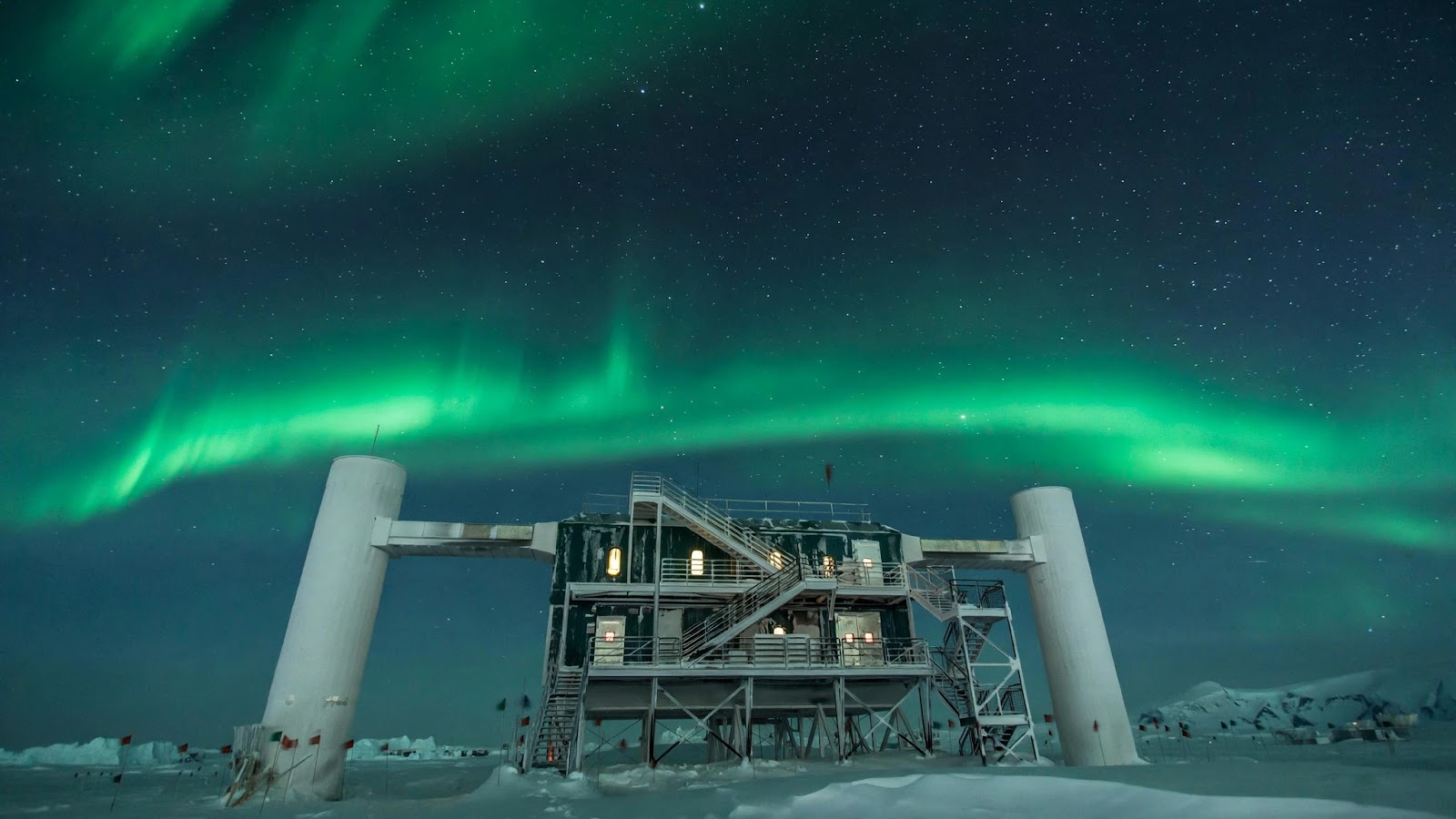
On October 6, 2026, the Royal Swedish Academy of Sciences awarded the Nobel Prize in Physics to Francis Halzen, the driving force behind the IceCube Neutrino Observatory. The prize honors a discovery that sounds like science fiction: we have learned to catch "ghost particles" streaming through the Earth from the most violent events in the universe, and to read them like messages from distant worlds.
Neutrinos are among the strangest things in physics. They are subatomic particles with almost no mass and no electric charge, produced in staggering numbers by the sun, nuclear reactors, supernovae, and the most extreme accelerators in the cosmos. What makes them "ghostly" is their shyness: a neutrino can pass through the entire planet — through rock, metal, and people — as if none of it were there. Trillions pass through your body every second, unnoticed. To catch even a few of the rare high-energy ones arriving from deep space, physicists had to build the largest scientific instrument ever constructed: a cubic kilometer of Antarctic ice wired with light sensors.
That instrument, IceCube, is the achievement the Nobel recognizes. It turned a billion tons of ancient ice at the South Pole into a telescope — not for light, but for neutrinos. And with it, humanity opened a genuinely new way of seeing the universe.
What Are Neutrinos, Really?
To understand why physicists are so excited, start with the particle itself. Every second, the nuclear fusion in the sun's core floods us with low-energy neutrinos. But the ones IceCube hunts are different beasts: high-energy neutrinos, carrying a million or even a billion times more energy, that must be born in cataclysms — exploding stars, supermassive black holes devouring matter, the jets of active galaxies.
Because neutrinos barely interact with anything, they travel in straight lines across the universe, unbent by magnetic fields and unabsorbed by the dust clouds that block ordinary light. That makes them the perfect cosmic messengers: unlike photons, they point straight back to where they were born. A high-energy neutrino arriving at Earth is, in effect, a postcard mailed from a cosmic accelerator billions of light-years away — delivered across the universe without so much as a crease.
The catch is that the same property that makes them perfect messengers makes them nearly impossible to detect. Catching one requires enormous patience and an enormous target.
A Cubic Kilometer of Ice as a Telescope
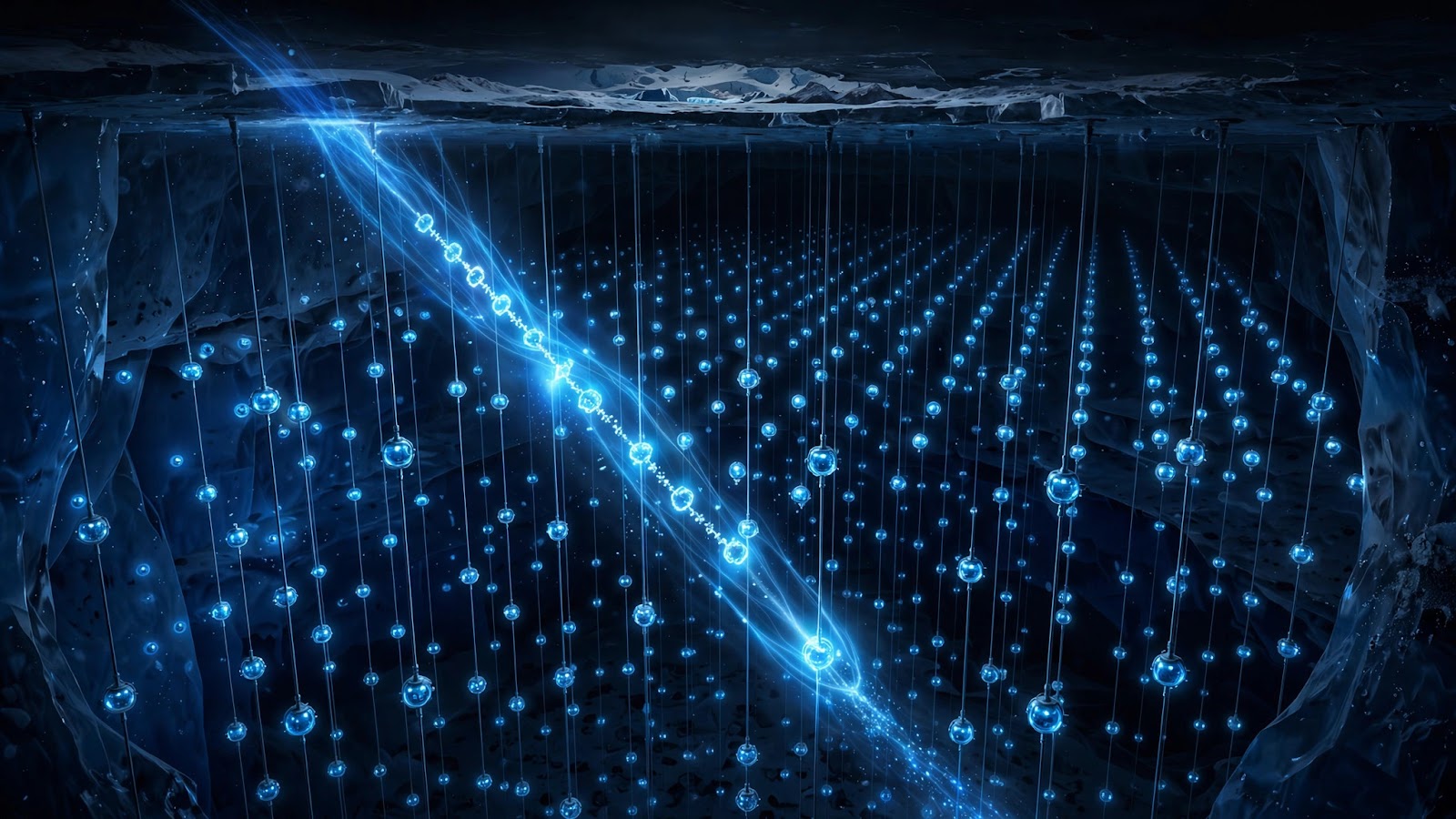
Francis Halzen's bold idea, pursued over decades, was to use nature's own material: the crystal-clear ice deep beneath the South Pole. Between 2004 and 2010, an international team drilled 86 holes more than two kilometers deep into the Antarctic ice sheet using hot water drills, lowering strings of sensitive light detectors into each borehole. When the water refroze, the sensors were locked permanently into the ice.
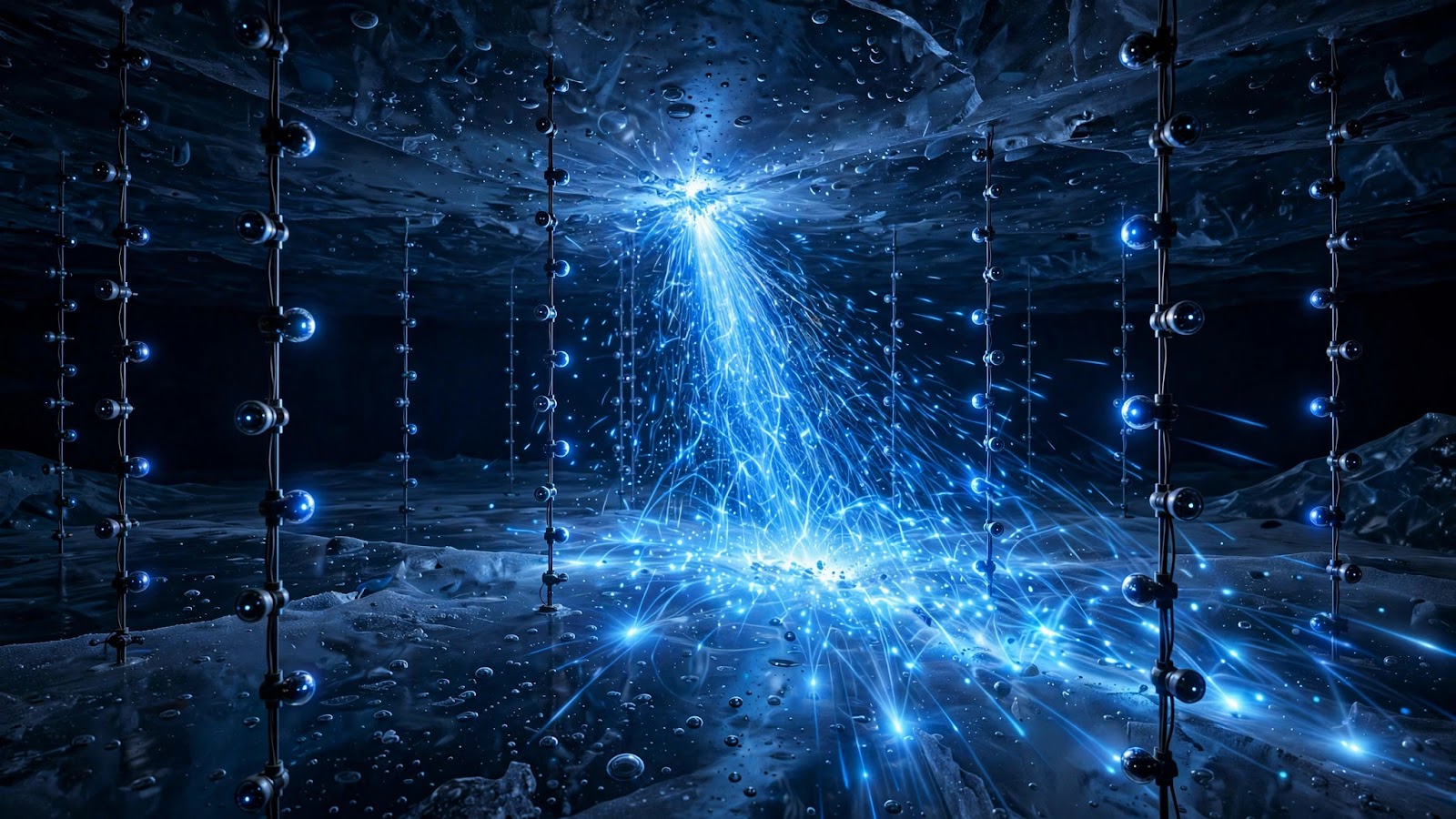
The finished detector is staggering in scale: 5,160 digital optical modules spread through a cubic kilometer of ice, each one a light sensor waiting in total darkness. When a neutrino very occasionally collides with an atom in the ice, it creates a charged particle moving faster than light can travel through ice — which produces a faint flash of blue light known as Cherenkov radiation. The sensors catch that flash and record its timing with nanosecond precision, allowing physicists to reconstruct the neutrino's direction and energy.
Think about the audacity of it: instead of building a detector, Halzen's team turned an entire continent's ice sheet into one. The Antarctic ice is some of the clearest solid material on Earth, buried deep enough to be shielded from everything except neutrinos and the muons produced by cosmic rays in the atmosphere above.
2013: The First Cosmic Neutrinos
For years the detector watched and waited, filtering out the flood of particles created by cosmic rays hitting Earth's atmosphere — the background noise against which the true cosmic signal had to be found. Then, in 2013, the IceCube collaboration announced the detection of 28 high-energy neutrinos that could not have come from Earth's atmosphere. They were cosmic.
It was the first time humanity had observed high-energy neutrinos from beyond our solar system. The energy range reached the "PeV" scale — a quadrillion electron volts, vastly beyond anything human accelerators can produce. These particles had to come from the universe's most powerful engines. The discovery proved that a diffuse glow of cosmic neutrinos washes over Earth from all directions — a background hum of the universe's violence.
For astronomy, this was a hinge moment. For centuries, everything we knew about the universe came from light — from visible light, then radio, X-rays, and gamma rays. A new messenger had arrived.
2017: The Blazar That Sent a Multimessenger Flare
The discovery's real drama came four years later. On September 22, 2017, a single high-energy neutrino — later nicknamed "Big Bird" by some and catalogued as IceCube-170922A — triggered an automated alert. Its reconstructed path pointed to a specific region of the sky, and within hours, telescopes around the world swung toward it.
There they found a blazar: TXS 0506+056, a supermassive black hole at the heart of a distant galaxy, firing a jet of particles almost directly at Earth — and it was flaring, brightening dramatically across the electromagnetic spectrum. Follow-up observations from the Fermi gamma-ray telescope and observatories worldwide showed the blazar in an active state, and archival IceCube data even revealed an earlier burst of neutrinos from the same source in 2014–2015.
This was multimessenger astronomy in action: the same cosmic event observed through two completely different carriers — light and neutrinos. It gave astronomers their first strong candidate for an individual source of high-energy cosmic neutrinos, and a template for how to hunt more of them. In the years since, IceCube and its partner observatories have chased more such alerts, building the case that blazars and other active galaxies are among the universe's natural particle accelerators.
The TXS 0506+056 episode is also worth comparing to other recent milestones in observational astronomy. Just as the James Webb Space Telescope has transformed how we see the distant universe in infrared light — revealing galaxies and cosmic structures previously hidden from view — IceCube opened an entirely different window onto the same cosmos, one written in particles rather than photons.
Why This Opens a New Astronomy
Astronomy used to have one sense: sight. The twentieth century added radio, infrared, X-ray, and gamma-ray vision — but all of these are still light, just at different energies. Then, in 2015, gravitational waves gave us a second sense: hearing the vibrations of spacetime itself when black holes collide. Neutrinos are now the third pillar — a sense of "touch" for the universe's most energetic events.
Each messenger tells a different story. Light can be blocked by dust and gas; gravitational waves reveal only the most massive, compact collisions; neutrinos point straight back to their sources and escape from regions so dense that even light cannot get out. Together, they let us cross-examine the universe: when a blazar flares in gamma rays and sends neutrinos too, we can test our models of how black holes accelerate particles to energies a million times beyond our best machines.
That is why the Nobel committee's choice matters beyond physics. Halzen's prize is not just for building a big detector; it is for founding neutrino astronomy as a working science — a new channel through which the universe speaks.
What Comes Next
IceCube's story is far from over. An upgrade adding more densely packed sensors is already enhancing its sensitivity, and a planned successor, IceCube-Gen2, would expand the instrumented volume nearly tenfold, catching the rarest, most energetic neutrinos and pinpointing their sources with far greater precision. Similar projects are rising in the Mediterranean Sea and in other locations, building a global network of neutrino telescopes.
The big open questions are tantalizing: exactly which objects produce the highest-energy cosmic rays, a century-old mystery that neutrinos may finally solve. What happens inside a blazar's jet? Are there neutrino sources we haven't imagined? Every new detection is a data point from a part of the universe no other instrument can probe.
There's a poetic symmetry worth noting. We search for signs of life on other worlds by scanning planetary atmospheres — like the phosphine traces once debated on Venus — while simultaneously listening to the universe's most violent neighborhoods through ghost particles. From the quiet chemistry of a planet's clouds to the roar of a feeding black hole, modern astronomy is learning to use every sense it has.
And the instruments keep getting bolder. On Earth, the largest digital camera ever built is preparing to photograph the entire sky night after night; at the South Pole, a cubic kilometer of ice keeps listening for the faintest blue flashes of particles that crossed the universe to reach us. Light, waves, and ghosts — together, they are writing the first complete biography of the cosmos.