
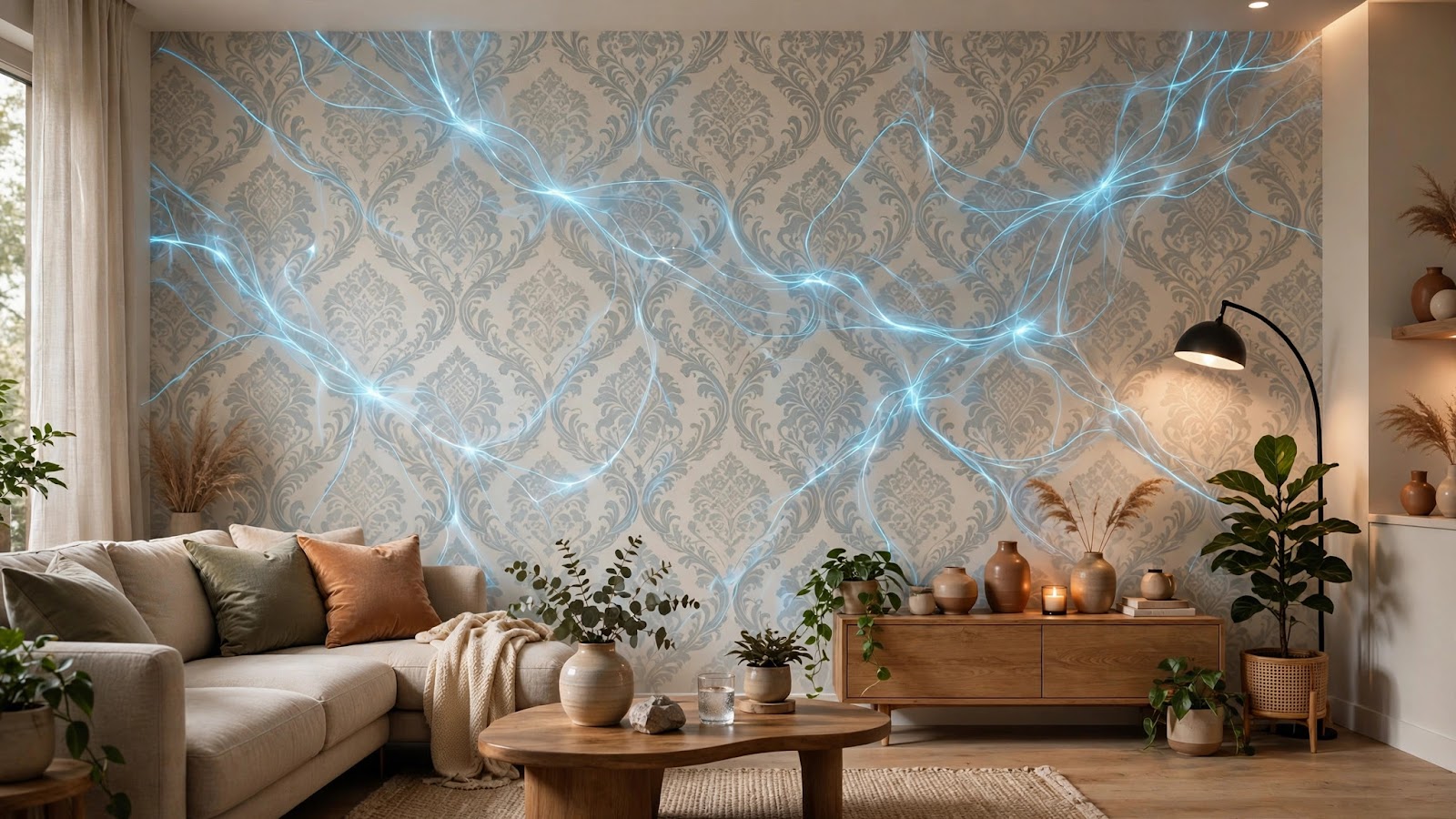
What if your walls quietly paid a small part of your electricity bill — not by facing the sun, but by drinking the dampness out of the air? On October 1, 2026, researchers at Binghamton University announced exactly that: a new kind of wallpaper that pulls moisture from an ordinary room and turns it into a stream of electric current. The work comes from Professor Seokheun "Sean" Choi's laboratory at Binghamton University and was published in the journal Advanced Energy Materials by Choi and his doctoral students Guangya "Roger" Yuan and Yang "Lexi" Gao.
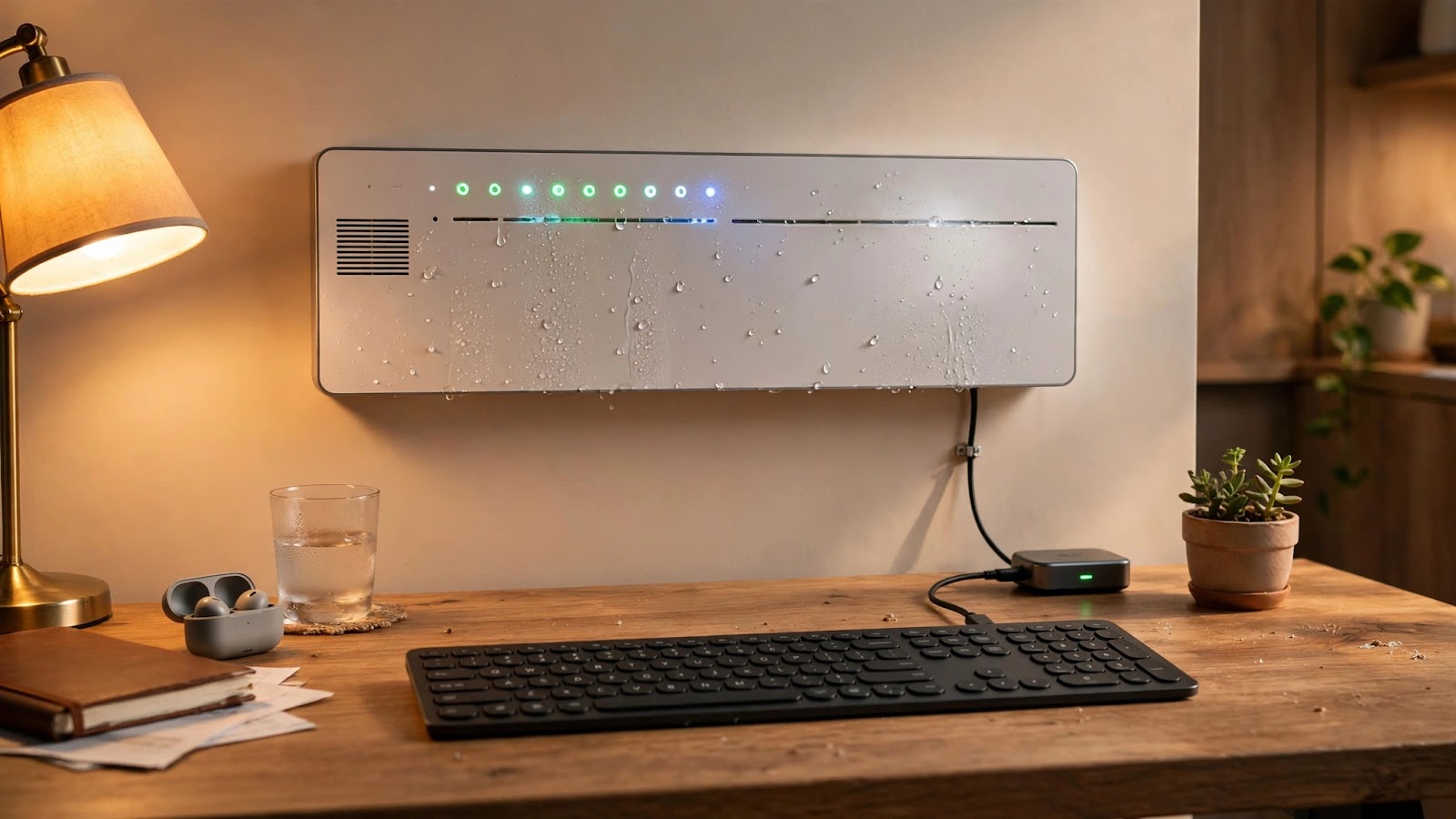
The headline demonstration was modest by design. The team assembled 1,596 tiny moist-electric generators into a single wallpaper panel, and that panel produced enough power to run a wireless keyboard. Each individual unit generated about 0.34 volts at 80 percent relative humidity. A wireless keyboard is not a dramatic load — and that is the point. This invention is aimed at the quiet, invisible layer of low-power devices filling modern homes, not at replacing the grid.
A Wallpaper Made of Tiny Power Stations
Each square of the wallpaper contains miniature devices called moist-electric generators, or MEGs. The idea is not new in principle, but making it work indoors — on a wall, invisibly, at the scale of a room — is the advance this paper claims.
The core trick is asymmetry. Most MEG designs use a vertical or horizontal layout with unevenly distributed materials: one region absorbs moisture while another encourages water to release or evaporate. That imbalance creates a lasting gradient of moisture and charged particles across the device, and the gradient drives charge separation — which is what we experience as voltage. The problem, the Binghamton team notes, is that these layouts waste space and struggle to keep moisture moving in one controlled direction once scaled up to wall-sized arrays.
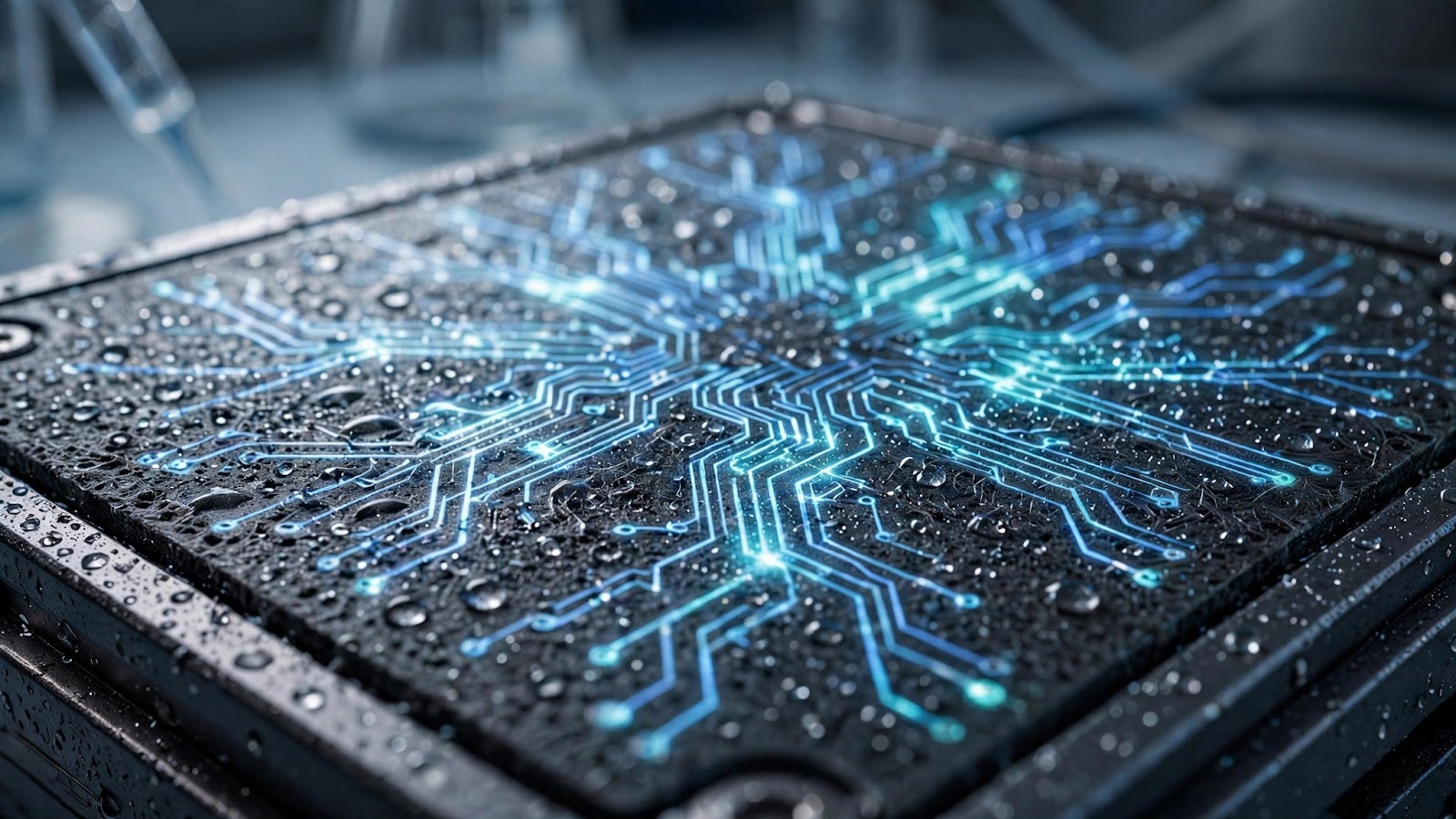
The team's answer draws on Choi's long-running field of papertronics — flexible, printable electronics built on paper substrates. Their new MEG architecture is described as resembling a microchip on a circuit board. Glycerol placed at the edges of each unit captures moisture from the air; a raised polyvinylpyrrolidone (PVP) structure in the center, patterned with a wax layer, controls how moisture is released and evaporates. The geometry steers water molecules from the absorption zone toward the evaporation zone, keeping the gradient stable and the power output continuous.
A second design feature hides the wiring: all of it sits on the back of the wallpaper, so the visible face can look like ordinary wall covering. The units were tested wired in series and in parallel, with similar results from both.
Choi wants the whole thing printable, because printability is the road to mass production and large-scale deployment. A hand-built laboratory sample rarely changes anything; a design that can roll off a printer can plausibly cover an entire room.
How Moisture Becomes Electricity
The physics behind the wallpaper is called hygroelectric or moisture-electric generation, and it is simpler than it sounds.
First, the material absorbs water vapor — at the glycerol-coated edges in the Binghamton design. The water molecules dissociate into positive and negative ions that drift through the material's structure. Because one side holds more moisture than the other, an ion-concentration gradient forms: more of one type of ion on top than on the bottom, for instance. That imbalance is a separation of charge, and separated charge is a voltage. Connect a circuit across it, and electrons flow. That flow is electricity.
The gradient must be sustained: if moisture soaked the material evenly, the gradient would collapse and the voltage would die. The engineered one-way moisture transport — absorption at the edges, controlled evaporation at the raised center — keeps fresh imbalance arriving, so the device generates power continuously rather than in a single fading burst.
It does not collect water: it exploits the process of water moving through a material to harvest energy, and the water itself stays vapor. Choi's fifteen years of biobattery research — devices that use bacteria to generate power — informed this approach; an earlier paper from the same lab used bacterial spores to break water molecules into ions inside paper capillaries.
Why Indoors Is the Right Habitat
There is a reason this wallpaper targets living rooms instead of rooftops. Choi himself notes that nearly all previous moisture-electric devices were designed for outdoor humidity, where there is abundant moisture but unstable conditions — blazing sunlight, storms, temperature swings — that make output unreliable. Indoors, relative humidity typically holds steady between 30 and 60 percent, and the people living in the room constantly add more: breathing, cooking, and bathing all release water vapor into the air.
That stability is the wallpaper's real advantage. It will never compete with rooftop solar on raw power, but rooftop solar goes to zero at night and on cloudy days. Indoor humidity never goes to zero in an occupied home. For devices that sip power continuously, a small, steady, always-on trickle is arguably more useful than a large, intermittent surge — the same logic behind other renewable energy sources for low-power electronics.
The Honest Limits: What the Numbers Say
Now for the part that matters most in invention-reportage: the limits. The figures the team reported are instructive precisely because they are small.
It took 1,596 units to power a wireless keyboard. That is the single most important fact in the announcement. A wireless keyboard is one of the least demanding electronic devices in a home — it draws only a trickle of current while typing and nearly nothing while idle. If fifteen hundred individual generators are needed to keep it running, then a phone, a tablet, or a laptop — which consume hundreds or thousands of times more power — are far beyond this technology's reach, and will remain so for the foreseeable future.
Each unit made about 0.34 volts. That is a fraction of the 1.5 volts in a single AA battery, and it was measured at 80 percent relative humidity — considerably damper than the 30 to 60 percent Choi cites as typical for indoor spaces. Output falls as humidity falls, so the performance in a real living room would be lower than in the laboratory test. The wallpaper is a high-humidity technology: it thrives in bathrooms, kitchens, and tropical climates, and it starves in dry, air-conditioned offices.
Power output is microwatt-scale per unit. The team does not present this as a grid technology, and it should not be described as one. Series and parallel wiring let the units pool their output, but pooling many microwatts still yields only milliwatts — enough for the Internet of Things' smallest citizens, such as environmental sensors and wireless communication modules, and not enough for anything with a motor, a heater, or a bright screen.
The paper shows a working panel, not a product. Durability over years of wallpaper life, cost per square meter, how the material handles paint and cleaning, and whether the output survives real indoor humidity cycles are all open questions. Choi's stated goal of making the design fully printable is the right next step, because only cheap, scalable manufacturing turns a clever panel into something a builder would actually install. This is the familiar gap between invention and product — the same gap that separates every promising lab result from building-integrated power like solar shingles, which took years of engineering after the underlying photovoltaics were proven.
None of this diminishes the achievement. A wallpaper that generates usable electricity from room air — no wires visible, no batteries to replace, no sunlight required — is a genuine first. Honest limits are what separate a serious technology story from a press-release fantasy.
Where It Fits Among Ambient-Energy Harvesters
The moisture-electric wallpaper joins a crowded and creative field of devices that harvest energy from the environment: indoor photovoltaic cells that sip power from room lighting, thermoelectric generators that exploit temperature differences, piezoelectric materials that turn vibration into current, and antennas that scavenge radio-frequency energy from the air. Each has the same profile — tiny, continuous, free power — and the same constraint: enough for sensors, never enough for heavy loads.
What distinguishes the Binghamton approach is its medium. Every other harvester needs something extra: light, heat differences, motion, or radio signals. Humidity is simply there in any occupied room, rising and falling gently with daily life, requiring no equipment, no maintenance, and no occupant behavior changes. That makes it one of the most democratic energy sources imaginable — a technology that works in any home, in any climate with enough moisture, without the resident doing anything at all.
There is a second benefit hidden in the concept: the wallpaper absorbs moisture, which means it also regulates humidity. Modern buildings spend enormous energy on HVAC systems that dehumidify air; a wall covering that soaks up excess dampness while generating electricity does two jobs at once. In humid climates, that double function could be the feature that justifies installation even before the power output becomes impressive.
Zoom out, and the wallpaper is part of a larger story about where power is going. As batteries improve — including the solid-state battery technology now moving toward commercialization — the devices they serve keep shrinking and sipping. A world of trillion-sensor ambitions cannot run on replaceable coin cells; it needs power built into the environment itself. Wallpaper that harvests humidity is an early, literal version of that idea: the room becomes the battery.
What Happens Next
The path from here is clear, and the team has named it: printability, scale, and efficiency. If the glycerol edges, PVP structures, wax patterning, and hidden wiring can all be printed in one process, the cost per square meter could fall to wallpaper prices rather than electronics prices. If efficiency improves — the researchers say they hope to generate more power in future iterations — the panel that today runs a keyboard might one day run an array of sensors, a smart thermostat, or a wall-mounted display.
Building codes in humid regions already demand serious moisture control; a wall covering that contributes to it while paying for a fraction of its own cost in electricity is a proposition an architect can understand.
The October 1 announcement will not change how anyone powers their home this year. But it is a reminder of how invention actually works: not as a single world-changing breakthrough, but as a steady accumulation of small, real capabilities — a keyboard powered by room air, a wall that drinks dampness and gives back volts. The grid will keep doing the heavy lifting. The wallpaper just wants to handle the whisper-quiet work in the background. And 1,596 tiny generators, each making a third of a volt from nothing but room air, is a respectable place to start.