

The deep ocean is running out of air. As the planet warms, seawater can hold less dissolved oxygen, while shifting circulation and nutrient runoff feed the decay that consumes what remains. Marine scientists call this deoxygenation, and it is already squeezing fish and other animals into thinner and thinner layers of livable water.
But how far can it go? One of the best ways to answer that question is to look backward. Earth has been far hotter before, with carbon dioxide levels far above today's. If we could measure exactly how much oxygen reached the deep ocean during those hothouse eras, we would get a preview of where our own warming oceans may be heading.
The catch is that our tools for reading past oxygen have mostly been qualitative: they tell us oxygen went up or down, but not by how much. A study published this week in Geophysical Research Letters changes that. Led by Rong Huang, a team of researchers has calibrated a natural sensor hiding in seafloor mud for eons: microscopic magnetic crystals grown by bacteria, whose shapes quietly record the oxygen levels around them. The result is a new equation that converts these tiny fossils into actual numbers for ancient deep-sea oxygen.
The bacteria with built-in compasses
The crystals are made by magnetotactic bacteria, microbes that live in the top few centimeters of muddy seafloor around the world. Inside each cell, the bacteria grow chains of tiny magnetite crystals — an iron mineral — arranged like beads on a string. The chains act as miniature compass needles, letting the bacteria sense Earth's magnetic field and swim toward the water chemistry they prefer.
When the bacteria die, their crystals remain. Locked into sediments, they can survive for millions of years as magnetofossils — fossils far too small for any light microscope to resolve. Scientists have known about them for decades and have long suspected the crystals carry information about the environment in which they formed.
Microbes turn out to be some of the most inventive record-keepers on the planet — from Sukunaarchaeum, the tiny microbe redefining the limits of life, to these compass-building mud-dwellers, single cells keep leaving traces that rewrite what we know about Earth's history.

Cubes or bullets: crystals that read oxygen
The key discovery is that crystal shape tracks oxygen. Huang and colleagues examined more than 200 samples of modern ocean sediment collected from basins around the world, matching each sample to the oxygen levels measured in the water above it. Using a transmission electron microscope, they painstakingly documented more than 4,500 individual crystal grains — each one scarcely wider than one-thousandth of a human hair.
The pattern was striking. In sediments beneath low-oxygen waters, the bacteria tended to grow skinny, bullet-shaped crystals. Where the water carried more oxygen, the crystals grew as tiny cubes. And the shift was not only visible under the microscope — it also showed up in the crystals' magnetic properties, giving researchers a second, independent way to read the same signal.
Crucially, the pattern held steady across very different conditions: warm and cold water, salty and less salty seas, and sediments rich or poor in organic carbon. That robustness is what makes a good proxy. If the crystal-shape rule broke down every time the temperature changed, it would be useless for reading the deep past, where conditions were very different from today.

From a hint to a yardstick
Earlier work had already hinted that magnetofossils tracked oxygen in a relative sense — more of this shape, less of that one. What the new study adds is calibration: a quantitative relationship, expressed as an equation, that converts crystal measurements into estimated oxygen concentrations.
That step matters enormously. A relative proxy can tell a story about a single place — oxygen fell here — but it cannot easily be compared across regions, and it cannot feed into the computer models that simulate ancient oceans. An absolute number can do both. Researchers can now take a seafloor sample from tens of millions of years ago, pick out the bacterial magnetite, measure its shapes and magnetic properties, and read off an estimate of how much oxygen the bottom water actually held.
To see why that glimpse of the past matters so much, it helps to understand how warming reshapes ocean chemistry — our guide to the greenhouse effect and how it heats the planet walks through the mechanism step by step.
Why ancient oxygen is a climate question
Deep-ocean oxygen is one of the master controls on marine life. Animals need it to breathe; where it falls too low, ecosystems collapse into dead zones dominated by a few tolerant microbes. Oxygen also governs how carbon is stored: in well-oxygenated water, dead organic matter is efficiently broken down, while low-oxygen conditions let more carbon stay buried.
That is why scientists are so interested in the Paleocene-Eocene Thermal Maximum, about 56 million years ago, when Earth's surface warmed by 5 to 8 degrees Celsius within roughly 20,000 years — a blink in geological time — and the oceans broadly lost oxygen. It is the closest natural rehearsal we have for rapid modern warming, and earlier studies have already used magnetofossils to trace deoxygenation along the Atlantic's Walvis Ridge during that event.
There is another hint that magnetofossils and climate change go together. During parts of the Eocene, some 56 to 34 million years ago, bacteria grew magnetofossils about twenty times larger than usual — "giant" crystals shaped like needles, spindles, and spearheads — precisely when the planet was undergoing rapid warming. The new calibration gives researchers a sharper tool for reading those episodes.
And the present adds urgency. Today's oceans are losing oxygen as the climate warms — warmer water simply holds less of it — and the open question is how far the loss will go. A reliable yardstick for ancient oxygen lets scientists test their models of ocean oxygen against real measurements from past hothouse climates, making forecasts of our own future more trustworthy.
What happens next
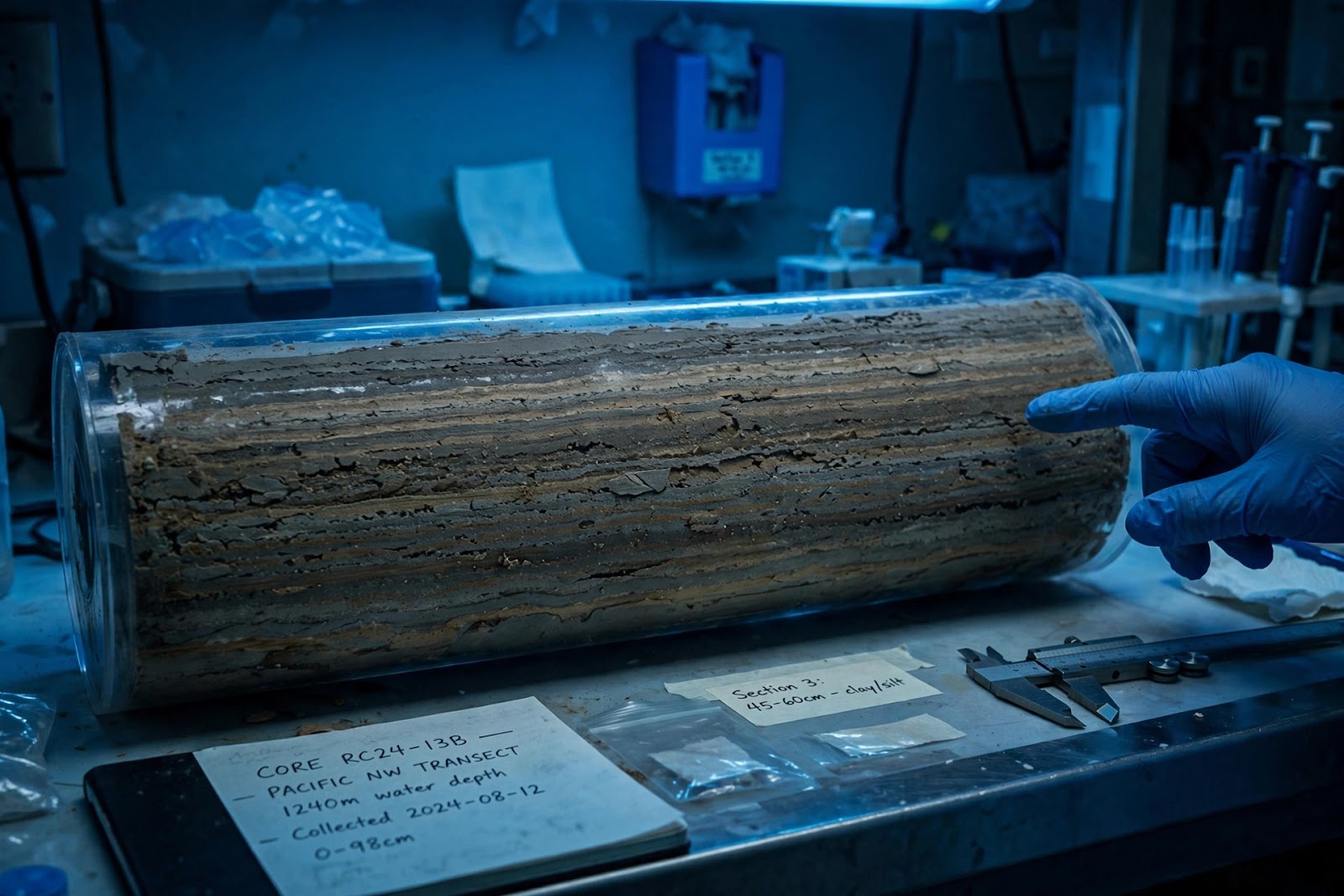
The immediate next step is to point the new proxy at old sediments. Ocean drilling expeditions have recovered cores from every ocean basin, some reaching back tens of millions of years — layered archives where magnetofossils are already known to be preserved. Applying the calibration to those cores could produce the first quantitative maps of deep-ocean oxygen across ancient warming events.
There is also a practical advantage baked into the discovery. Because crystal shape changes the crystals' magnetic properties, researchers do not always need to image thousands of grains one by one. High-resolution magnetic measurements can detect the fingerprint of different iron-oxide particles in bulk sediment — a faster, non-destructive way to survey long cores. That makes it realistic to screen the vast core libraries drilled over decades by ocean drilling programs, turning archived mud into a planetary oxygen archive.
No proxy is perfect, and the new equation will need care in practice. Burial can alter magnetic minerals over time, and local sediment chemistry can complicate the signal, so future work will have to test the calibration against independent oxygen indicators. But because the underlying pattern survived such different modern environments, the tool looks widely applicable — a rare thing in paleoclimate science, where most proxies only work under narrow conditions.
Tiny compasses, big answers
There is something poetic about the finding. The smallest navigators on the planet — bacteria steering by Earth's magnetic field in the dark mud of the seafloor — have been keeping a logbook of ocean oxygen all along. We just needed to learn how to read their handwriting. Now that we can, a grain of magnetite one-thousandth the width of a human hair may help answer one of the biggest questions in climate science: how much air did the ancient deep ocean hold — and how much might ours have left?