
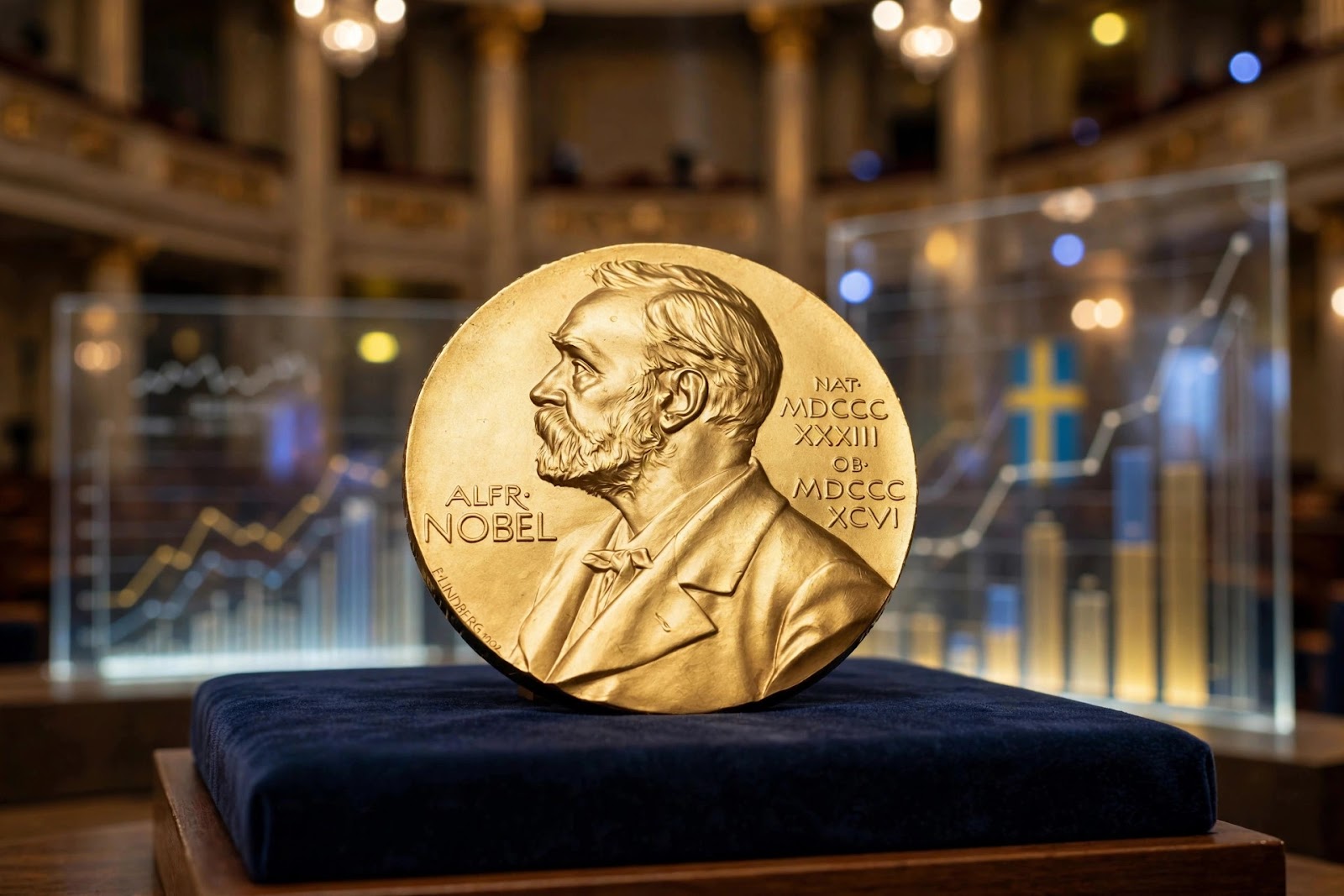
Two American economists who gave central banks their modern playbook for fighting inflation and cushioning recessions have won the 2026 Nobel Prize in Economics. Robert E. Hall of Stanford University and Michael Woodford of Columbia University were named the laureates on Monday, October 12, 2026, at the Royal Swedish Academy of Sciences in Stockholm, honored "for microeconomic foundations of macroeconomic stabilisation."
In plain language: their work explains how the small, everyday decisions of households and businesses add up to the big swings of the economy — booms, busts, inflation surges and recessions — and how governments and central banks can act to soften those swings. Their ideas grew into the models that central banks around the world now use when they set interest rates, fight inflation, and respond to crises.
The announcement
The prize was announced in Stockholm by John Hassler, chair of the Committee for the Prize in Economic Sciences. The committee stressed that no matter what causes an economic shock, a central goal for governments and central banks is to reduce the size of the swings and to keep the economy from getting stuck with high unemployment or runaway inflation.
The two laureates will share a prize sum of 12 million Swedish kronor (roughly €1.07 million). The medals and diplomas will be presented at the traditional ceremony in Stockholm on December 10, the anniversary of Alfred Nobel's death.
A technical note for curious readers: although we all call it the Nobel Prize in Economics, its official name is the Sveriges Riksbank Prize in Economic Sciences in Memory of Alfred Nobel. It was created in 1968 by Sweden's central bank and first awarded in 1969. This year's announcement closes out the 2026 Nobel season, which The Global Spy has covered all month — including our report on the 2026 Nobel Prize in Chemistry.
Who are the winners?
Robert E. Hall, 83, is a longtime professor of economics at Stanford University and a senior fellow at its Hoover Institution. Born in Palo Alto, California, in 1943, he earned his bachelor's degree from UC Berkeley and his PhD from MIT in 1967.
Hall is something of an insider's insider in American economics. Since 1978 he has chaired the Business Cycle Dating Committee of the National Bureau of Economic Research — the small, discreet panel whose official verdicts decide when U.S. recessions begin and end. When newspapers report that "the NBER says the recession started in March," that is Hall's committee talking.
His pathbreaking work came early. In 1978, Hall showed that households don't decide how much to spend based only on the money in their pockets today — they look ahead, weighing what they expect to earn in the future. Only genuine surprises about future income, he argued, should move spending. The insight became a cornerstone of modern thinking about consumption. He later wrote widely about recessions and unemployment, including the book The Long Slump, and co-authored the famous flat-tax proposal with Alvin Rabushka.
Michael Woodford, born in 1955 in Chicopee, Massachusetts, is the John Bates Clark Professor of Political Economy at Columbia University. Like Hall, he earned his economics PhD at MIT, in 1983.
Woodford's landmark achievement is his 2003 book Interest and Prices: Foundations of a Theory of Monetary Policy, which became the bible of modern central banking. He built a complete model of the economy from the ground up — from how families and firms behave — and showed how a central bank can use interest rates and, crucially, its own communication to keep prices stable and output steady.

What did they actually discover? A plain-language guide
The core question behind this year's prize is one of the oldest in economics: why does the economy swing between booms and busts, and what can be done to make the ride smoother?
After the Great Depression, the British economist John Maynard Keynes gave policymakers a recipe: when the economy slumps, cut interest rates and taxes and raise government spending to restart demand; when it overheats, do the opposite to cool inflation. For decades, it worked. Then, in the 1970s, oil shocks hit the West and the recipe broke — unemployment and inflation rose together, something the old models said shouldn't happen. Policymakers were flying blind.
Hall and Woodford helped write a new manual. Their key move was to stop treating the economy as a machine with mechanical links between big totals — inflation, output, consumption — and instead build the analysis from the bottom up: from the choices of real households and businesses. Economists call this "microeconomic foundations," the phrase in the prize citation. Three ideas matter most.
1. People look forward, not backward. Hall's insight, from that 1978 paper, was that a family's spending depends on what it expects to earn over its lifetime, not just this month's paycheck. A one-off bonus may be saved; a raise you expect to keep gets spent. That means the way a government or central bank talks about the future can change what people do today. A credible promise — or threat — about future policy moves the economy now.
2. Prices are "sticky." If every shop could change its prices instantly and costlessly, the economy would adjust smoothly to every shock. In reality, prices are sticky: menus are reprinted, contracts are signed, wages are negotiated in rounds. When a shock hits, output and jobs absorb the blow instead. Woodford's models put sticky prices at center stage, showing how this everyday friction turns small disturbances into economy-wide waves — and how monetary policy can lean against those waves.
3. Words are a policy tool. This is Woodford's most influential legacy: a central bank's communication — its promises about where interest rates are heading, its press conferences, its inflation targets — is not decoration on top of policy. It is policy. By shaping what households and businesses expect, clear communication can steady the economy with fewer painful rate swings. The practice now has a name every market watcher knows: forward guidance.
Together, these ideas became the New Keynesian models — the standard toolkit inside central banks from Washington to Frankfurt to Tokyo.
How central banks actually use this work
The connection between a chalkboard model and your mortgage payment is more direct than it looks.
When inflation surged worldwide after the pandemic — driven by snarled supply chains, energy shocks and a rebound in spending — central banks faced a brutal dilemma: raise rates hard and risk recession, or go easy and risk inflation getting entrenched. The models built on Hall's and Woodford's foundations gave policymakers a structured way to think through that trade-off: how fast expectations might shift, and how clear communication could do part of the heavy lifting.
The Nobel committee made exactly this point, saying the laureates' research made it possible to manage major macroeconomic crises far more effectively than before, and that it proved hugely beneficial during the pandemic and the energy crises of recent years. Energy markets have stayed on edge through geopolitical flare-ups ever since — from supply scares to the row over Trump's Russian diesel deal — which is why tools for managing shocks matter so much right now.
Forward guidance is the most visible product of this thinking in daily life. When a central bank chief steps to a podium and signals that rates will stay steady for a while, that is Woodford's insight in action: anchoring expectations so that businesses invest, banks lend, and households plan with confidence rather than fear.
Why this prize, why now
Nobel prizes often reward work decades old — the committee waits until an idea has proven its worth. This one lands at a moment when its subject could not be more topical.
The world has just lived through the sharpest inflation shock in a generation. The pandemic pushed millions out of work; the supply shocks and energy crises that followed drove up the cost of living everywhere. Even where inflation has cooled, the cost of living remains the dominant economic anxiety in household after household. With the United States heading into midterm elections, the economy — prices, jobs, interest rates — is again at the center of political argument.
The committee's choice reads as a quiet statement about what economics is for. In an era of shocks — pandemics, energy crises, trade disruptions — the prize goes to the people who gave policymakers better tools to absorb them.
What it means for ordinary people
You will never read a Hall or Woodford equation before breakfast, but their fingerprints are on the economic weather around you.
When a central bank raises interest rates to fight inflation, it is following a playbook their work helped write: cool demand enough to bring prices back in line, while trying not to tip the economy into recession. That decision flows through to car loans, credit cards and mortgages. When a central bank communicates clearly about its plans, it is trying to keep your expectations — and therefore your spending and your employer's hiring — steady rather than panicky.
The models also explain why policymakers obsess over expectations surveys and market signals: what people believe about future inflation partly determines actual inflation. If workers expect prices to keep rising, they demand bigger raises; if shops expect rising costs, they raise prices pre-emptively.
None of this is investment advice, and economics at this level doesn't hand out stock tips or forecasts. What it offers is a clearer picture of the forces shaping prices, jobs and interest rates — and of why the people in charge do what they do.

Reactions and outlook
Both laureates described the award as a surprise. Woodford, speaking to the committee by phone from New York, called it "a tremendous honor." Hall said in a Stanford statement that he had spent his career "trying to understand how the economy works, following interesting questions wherever they led."
Economists outside the committee broadly welcomed the choice, noting that few prizes have rewarded work so directly embedded in daily policymaking. The research agenda the laureates opened is still running: Woodford's recent work on bounded rationality — the idea that people process information imperfectly — is pushing the models to account for how humans actually think, not just how idealized agents would.
The deeper outlook is humbler and more permanent. Economies will keep being hit by shocks nobody predicted — that much is certain. The prize honors two careers spent making sure that when the next shock comes, the people in charge have better instruments, sharper maps, and clearer words than they had before. For the rest of us, that is the difference between a rough patch and a lost decade.