
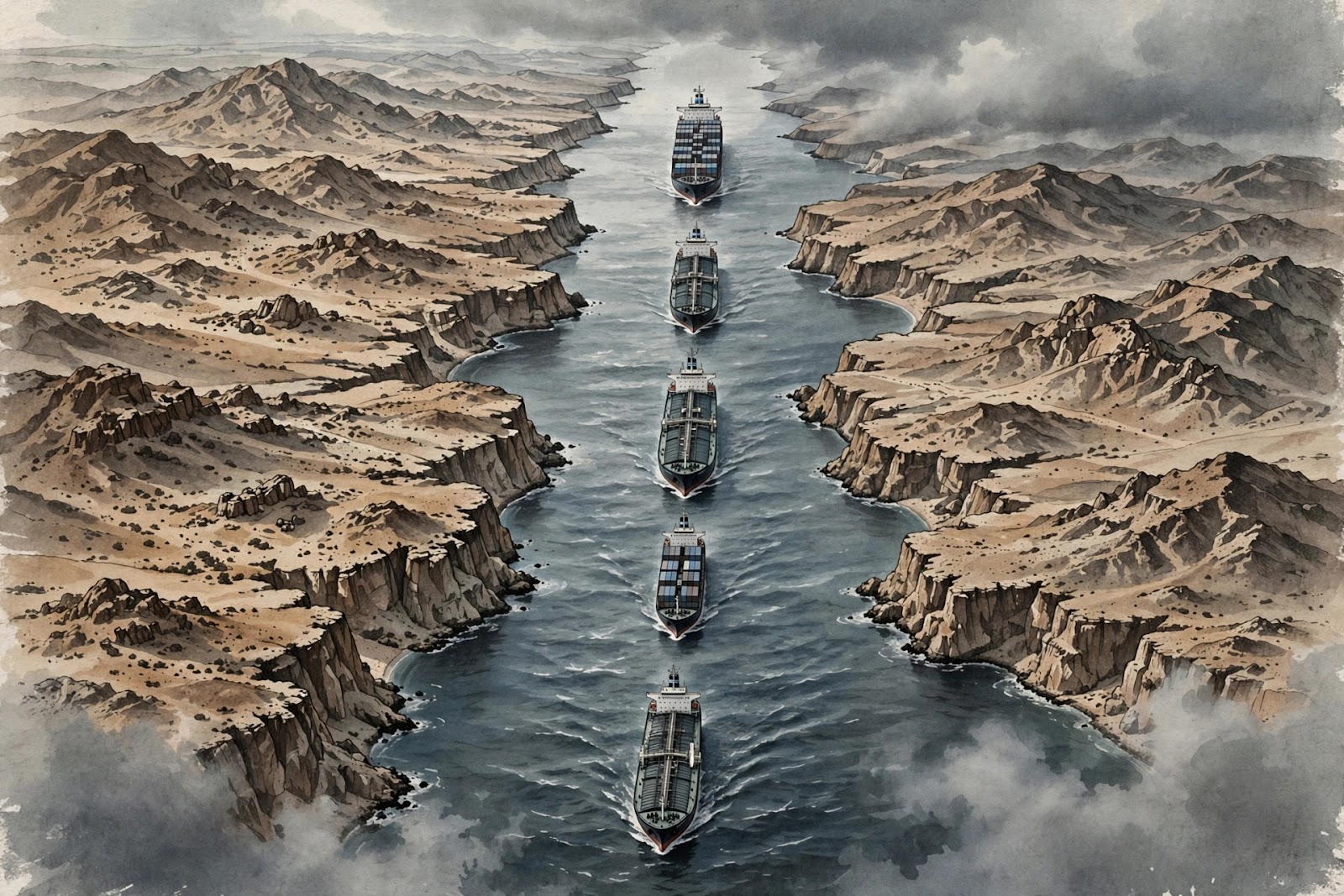
The Strait of Hormuz is only about 33 kilometers wide at its narrowest point. Yet this sliver of water between Iran and Oman is shaping up to be the fault line of the world's next food crisis. The United Nations has warned that failure to get fertilizer moving through the strait again within weeks could trigger a food emergency in parts of Asia and Africa — and that warning is landing in a week when military planners, finance ministers, and oil traders are all watching the same patch of sea.
What happened this week
The week began with a CNN report, published October 15, that the US military has drawn up new strike plans for Iran that could include the GBU-43/B Massive Ordnance Air Blast bomb — the "mother of all bombs" — against Iranian energy infrastructure and nuclear sites. The plans are contingent on President Donald Trump ordering a resumption of combat operations, and they reportedly include a possible strike on a heavily fortified site known as Pickaxe Mountain, where the US and Israel believe parts of Iran's nuclear program are stored. Officials cited in the reporting have questioned whether the bomb could actually destroy deeply buried facilities, and whether using it near populated areas would put civilians at risk.
Trump himself, speaking in Montana late Wednesday, said the Iran war would end "very soon" and predicted that "oil prices will drop like a rock" once it did. He also claimed US strikes had devastated Iran's navy, air force, and military leadership.
On the water, the danger is no longer hypothetical. A Singapore-registered vessel reportedly sank in the strait this week after attacks on two ships, and commercial traffic through the chokepoint remains badly disrupted. Iran has tightened its grip on the waterway since US and Israeli strikes on February 28, while Washington has pressed a naval blockade of Iranian ports.
The fighting has already spilled onto social media. On October 15, the platform X suspended more than 13,000 accounts it linked to three suspected foreign influence operations tied to Iran, Russia, and China, saying the networks used fake accounts to amplify political content aimed at US candidates across the political spectrum ahead of the November 3 midterm elections. X published no public evidence for its attribution, so that claim should be read with the usual caution.
Why Hormuz threatens food as much as oil
Most coverage of Hormuz is about oil, and with good reason: crude prices have sat above $100 a barrel for much of the past eight months, and the G20 finance gathering in Bangkok this week is dominated by the energy-price shock. But the UN's warning this week is about something the oil coverage usually misses — the waterway is also a fertilizer highway.
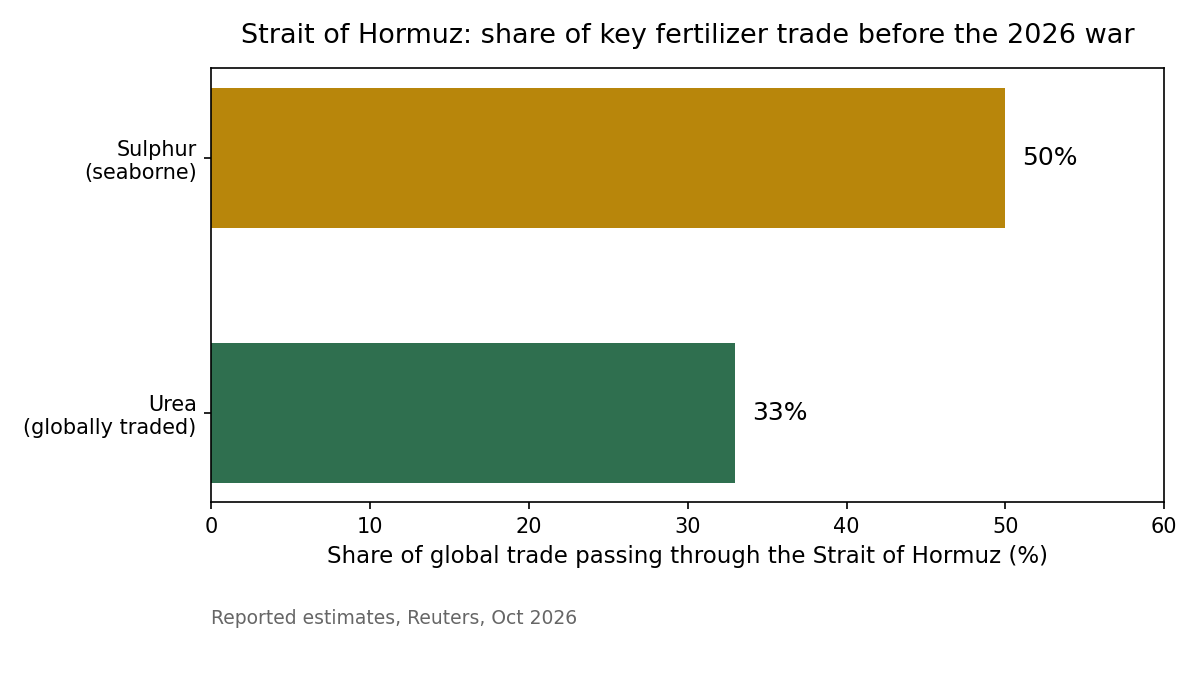
Before the war, the Strait of Hormuz handled roughly one-third of all globally traded urea, the most widely used nitrogen fertilizer on the planet, and nearly half of all seaborne sulphur, a key fertilizer input, according to reporting based on trade data. The Gulf states are among the world's biggest fertilizer exporters, and almost everything they ship to Asia and Africa has to pass through Hormuz.
The Washington-based International Food Policy Research Institute said last month that fertilizer shipments out of the Gulf have remained largely halted more than six months after the conflict began. Fertilizer made up a "very negligible" share of the limited shipping that resumed during a brief mid-June to mid-July ceasefire.
Oil is consumed in weeks; fertilizer determines harvests months ahead. Miss the planting window, and the food is not late — it is smaller. Analysts call this the lag problem: a shipping disruption today becomes a production shortfall in six to nine months, which becomes a food-price spike after that. A Hormuz disruption, in other words, is not a one-quarter event. It is a chain reaction with a fuse measured in planting seasons.
The countries at the sharpest end of that chain are the ones that import both their food and their fertilizer inputs — many in South and Southeast Asia and sub-Saharan Africa. These are the same regions where millions of people already live on the edge of food insecurity, as our coverage of Indonesia's wildfire crisis that affected 12.5 million people showed: one shock piles onto another in economies with the least cushion.
The UN's fertilizer plan — and why it is stuck
The UN set up a taskforce in March to fix exactly this problem, working with UN Trade and Development, the International Maritime Organization, and the International Chamber of Commerce. The mechanism it designed would coordinate the movement of fertilizer and related raw materials through the strait under some form of agreed safe passage — think of it as a protected lane for the world's food inputs, modeled loosely on past maritime corridors.
The mechanics are reportedly ready. UN official Jorge Moreira da Silva said the plan could be activated within seven to ten days of an agreement between Washington and Tehran. The hold-up is political, not technical: the US and Iran have not agreed on the terms, and each round of strike planning makes an agreement harder.
Da Silva's warning, delivered on the sidelines of the IMF and World Bank annual meetings in Bangkok, was blunt: "It's absolutely crucial to get the deal in the next few weeks. Otherwise, we will miss the planting season."
The US State Department, asked about the plan, said the US military has helped thousands of commercial vessels transit the strait and would "continue to take decisive action against Iran's attempts to disrupt freedom of navigation." That is not a rejection of the UN mechanism — but it is not an agreement either.

The G20 room is worried about more than oil
Finance ministers and central bank governors from the world's largest economies gathered in Bangkok this week for the G20 meetings alongside the IMF and World Bank annual sessions, with the Iran war's economic fallout at the top of the agenda. The US-Israel war on Iran, now in its eighth month, was described in advance as the biggest-ever energy supply shock, and crude prices above $100 have been feeding inflation across multiple economies.

Australia's treasurer, Jim Chalmers, said he would use the meeting to push for an end to the Middle East conflicts and the reopening of Hormuz, arguing both are needed to restore global economic stability. Notably absent: US Treasury Secretary Scott Bessent, who sent deputies instead. Federal Reserve Board Chairman Kevin Warsh is attending.
The significance here goes beyond diplomacy. When G20 finance ministers spend their week on one war's fallout, markets read it as confirmation that the risk is priced for duration, not for a quick resolution. Energy traders price the war into fuel; grain traders have started pricing the planting-season risk into next year's crops. The two shocks reinforce each other: expensive diesel raises the cost of planting, harvesting, and transport even where fertilizer is available — a double squeeze our analysis of Trump's Russian diesel deal that sparked a "gift to Putin" row shows is already a live fight in fuel markets.
The information front: X's mass suspension
The X takedown of 13,000-plus accounts is worth reading as a signal, not just a moderation story: platforms announce mass removals when an information fight is intensifying — here, around both the Iran war and the November 3 US midterms. But X published no public evidence linking the accounts to Iran, Russia, and China, and one week earlier OpenAI said it had disrupted two similar influence campaigns linked to Russia and Iran. In this environment, readers should treat viral claims about sinkings, strikes, and casualties with extra skepticism.
What happens next: three scenarios
Scenario 1: A deal within weeks. Washington and Tehran agree to the UN fertilizer mechanism, and ships start moving within 7-10 days. Fertilizer reaches Asia and Africa before planting windows close; the food crisis stays a warning. This is the UN's ask — and, given the current strike planning, its hardest case.
Scenario 2: Managed stalemate. No deal, but shipping lanes hold at current reduced levels and the war pauses. Fertilizer flows stay thin, planting seasons slip, and 2027 brings smaller harvests and higher food prices in import-dependent countries — a slow-burn crisis rather than an emergency. This is arguably where we are now.
Scenario 3: Escalation. The MOAB plans stop being plans. Strikes on Iran's energy infrastructure would almost certainly close or severely restrict Hormuz for a period, spiking oil further and freezing fertilizer shipments entirely. The food warning would stop being a warning.
Which scenario plays out depends on whether Washington and Tehran can keep negotiating a food corridor while preparing military options.
Diplomacy outside the war track continues in parallel — our explainer on India's three-part peace plan to end the Ukraine war shows how middle powers are trying to carve out negotiating space in overlapping conflicts. Whether that model can reach Hormuz is an open question.
What to watch this week
- Any US-Iran statement on the UN fertilizer mechanism — a yes/no within weeks decides Scenario 1 vs. 2.
- Shipping data through Hormuz — vessel counts and insurance rates are the real-time pulse of the corridor.
- G20 communique language on Hormuz and food security — coordinated wording means coordinated pressure.
- Urea and grain futures — if traders start betting on a 2027 production shortfall, prices move before the harvest does.
- Trump's posture after the midterms — the CNN reporting suggested strikes could come before or after November 3; his Montana remarks said "very soon."
The bottom line: Hormuz is not just an oil story anymore. The UN is warning that a few dozen kilometers of water now stand between millions of farmers and their next planting season. Whether that warning becomes history will be decided in the next few weeks — in Bangkok meeting rooms, on the strait's shipping lanes, and in Washington and Tehran.